(some changes have been made from my previous posts, will update accordingly) Best Picture 2019: Parasite
Runner-up: The Lighthouse
3. 1917
4. Little Women
5. The Irishman
6. Uncut Gems
7. Jojo Rabbit
8. The Farewell
9. Avengers: Endgame
10. A Hidden Life Best Director 2019: Bong Joon-ho, Parasite
Runner-up: Sam Mendes, 1917
3. Robert Eggers, The Lighthouse
4. The Safdie Brothers, Uncut Gems
5. Greta Gerwig, Little Women Best Actor 2019: Willem Dafoe and Robert Pattinson, The Lighthouse
Runner-up: Adam Sandler, Uncut Gems
3. George MacKay, 1917
4. Roman Griffin Davis, Jojo Rabbit
5. Adam Driver, Marriage Story Best Actress 2019: Saoirse Ronan, Little Women
Runner-up: Valerie Pächner, A Hidden Life
3. Scarlett Johansson, Marriage Story
4. Lupita Nyong'o, Us
5. Jessie Buckley, Wild Rose
Best Supporting Actor 2019: Al Pacino, The Irishman Runner-up: Joe Pesci, The Irishman 3. Timothée Chalamet, Little Women
4. Song Kang-ho, Parasite
5. Sterling K. Brown, Waves Best Supporting Actress 2019: Zhao Shuzhen, The Farewell
Runner-up: Florence Pugh, Little Women
3. Scarlett Johansson, Jojo Rabbit
4. Cho Yeo-jong, Parasite
5. Park So-dam, Parasite Best Ensemble 2019: Parasite
Runner-up: Jojo Rabbit
3. Little Women
4. The Farewell 5. The Irishman Best Original Screenplay 2019: Parasite
Runner-up: The Lighthouse
3. Uncut Gems
4. Marriage Story
5. Portrait of a Lady on Fire Best Adapted Screenplay 2019: Little Women Runner-up: The Irishman 3. The Farewell 4. Jojo Rabbit 5. El Camino Best Cinematography 2019: 1917 Runner-up: The Lighthouse 3. Portrait of a Lady on Fire 4. Parasite 5. A Hidden Life Best Editing 2019: Parasite Runner-up: Uncut Gems 3. The Irishman 4. The Lighthouse 5. Little Women Best Costume Design 2019: Jojo Rabbit Runner-up: Little Women 3. Once Upon a Time in Hollywood 4. The Aeronauts
5. Vita and Virginia Best Production Design 2019: Parasite Runner-up: 1917 3. The Lighthouse 4. Little Women 5. Once Upon a Time in Hollywood
Best Sound Editing 2019: The Lighthouse
Runner-up: 1917
3. Apollo 11
4. Ford v Ferrari
5. Midsommar Best Sound Mixing 2019: 1917 Runner-up: The Lighthouse 3. Parasite
4. Uncut Gems 5. Ad Astra
Best Visual Effects 2019: 1917 Runner-up: The Lighthouse
3. The Irishman
4. The Aeronauts
5. Godzilla: King of the Monsters Best Makeup and Hairstyling 2019: The Lighthouse
Runner-up: Bombshell
3. The Irishman
4. Midsommar
5. Monos
Best Original Score 2019: 1917 Runner-up: A Hidden Life
3. Parasite
4. Avengers: Endgame
5. Little Women
Best Original Song 2019: 'Stand Up' - Harriet
Runner-up: 'Glasgow', Wild Rose 3. 'I'm Gonna Love Me Again', Rocketman 4. 'Speechless', Aladdin 5. 'Beautiful Ghosts', Cats
Top: Josh and Benny Safdie, Uncut Gems
Bottom: Vince Gilligan, El Camino; Martin Scorsese, The Irishman
There's nothing wrong with a director going back to a tried and tested formula that suits their strengths, and really in the most basic sense that's what these four gentlemen have done with their respective films. There's a reason I'm talking about the following here as each director not only finds something new to offer this time around, they completely re-evaluate and turn in an entirely vivid, new experience for their films I'd never experienced from them before. Vince Gilligan returning to the biggest hit television series of all-time in El Camino gives one the opportunity to hone in on what Jesse Pinkman's been up to since we last saw him making his escape in the Breaking Bad finale. Which was a perfect ending in itself, but what Gilligan does here is craft the perfect epilogue to it. He explores what got Jesse into this situation and what will get him out of it, and creates such an affecting, tense portrait that narrows in on a contemplative exploration of Jesse, and the film works all the better for finding new ground to tread on instead of trying to recreate the Breaking Bad magic. The Safdie brothers Josh and Benny once again turning to a 'man on the ledge' genre to play with in Uncut Gems, presenting us with another dickhead to root for, this time around switching fromGood Time's selfish, high-wire toxic Connie to the selfish, high-wire, toxic but altogether more wealthier Howard. We get a character who once again repeatedly puts himself in ridiculous situations, and through it the Safdies create, through all their technical excellences and conjuring up brilliant performances across the board, the unforgiving world of the New York diamond district where the character bounces off once fuckup after another repeatedly trying to find a way out, and making tension and anxiety over a frankly repulsive individual which is just remarkable. Martin Scorsese makes what might be his last go-around on the mobster genre ride in The Irishman. His decision to make a film about such a decidedly passive character and gradually hone in more and more on him as history unfolds across him is brilliant. Like Gilligan and the Safdies he presents us with a figure going through all sorts of situations that he's played around it before, and like them he presents his protagonist, Frank Sheeran, in an altogether different light, a nostalgic light that's gradually torn away as history catches up to him and he simply can't keep up with it. It's marvellous work from all three directors in conjuring up such compelling narratives, all essentially driven by presenting such a vivid, unforgettable wide scope and then fixating upon such compelling individuals.
Left: Terrence Malick, A Hidden. Life
Right: Céline Sciamma, Portrait of a Lady on Fire; Lulu Wang, The Farewell
Terrence Malick has spent the past few years directing glorified perfume adverts, so it's nice to see A Hidden Life as a return to form for him. It's by no means a perfect film, overlong and in need of a more concise edit, but what's there is often very strong and occasionally rather brilliant. Malick once again returns to what really is his greatest strength which is in capturing emotional intimacy in unlikely situations, and the film really excels the most when he allows us to really reflect on and absorb the power of the central relationship. Whether it's showing snippets of an early courtship, letting the camera linger on a husband's joyous return and his heartrending departure, and while there are scenes which come across as pointless navel gazing, particularly in the second half, there are just as many astonishing ones which capture the power of the true story. Meanwhile, Lulu Wang's direction for The Farewell is more understated yet no less powerful in its poignancy. She really does well to sidestep any pitfalls of the indie genre by balancing naturalism with the laughs and drama, and coheres them into a loving, yet observant and take on the family dramedy genre. What I particularly love is that she lets the performances flourish so much without trying to divert attention away from them, which is generally a problem I have with a lot of films, when she does undertake more overt stylistic choices it works, for example the 'funeral' scene or the family wedding montage, but my favourite moments are subtle touches like how she silently uses the camera to tell us the inner emotions of characters. And Céline Sciamma for Portrait of a Lady on Fire crafts an unforgettable immersive experience within a striking romance. Sciamma of course makes use of glorious cinematography and a strong screenplay to fashion such a compelling yet simple narrative, yet what I really have to commend is her restraint. Yes, there are amazing sequences like the titular 'on fire' scene which is just an astonishing piece of stylistic direction, but I really liked too how she allowed other scenes to play out with relative normalcy and calm, and never battering you over the head with the 'passion' between the two character but rather letting it be drawn out and slowly build up. And I keep mentioning it but that ending really is one of the most brilliant pieces of direction of the year.
Alejandro Landes, Monos
Robert Eggers, The Lighthouse; Sam Mendes, 1917
Then you have directorial efforts which really go for the grand, epic, daring scope of capturing very specific atmospheres. In this regard, Alejandro Landes' work on Monos does a terrific job of capturing a consistently unnerving tone. You get pulled into this claustrophobic, hellish little world of child soldiers and the film never really lets go over its duration, and I really dug how Landes keeps these figures at a certain distance from the rest of the world, the isolation which creates even more sense of this often surreal environment. The film is very loosely plotted and the actors while uniformly strong are all very much within the director's vision which is the domineering aspect of the film. Landes runs with this disorientating mad experience and whether or not you like it, you got to admire it. Robert Eggers' The Lighthouse is also madness of an altogether different sort. It's honestly the kind of direction that gets the better the more I think about it, as Eggers does with the likes of Fritz Lang, Bergman, black and white horror cinema on the whole, what someone like Todd Phillips failed to do with Scorsese in Joker. In that the influence on his work is keenly felt, yet it is very much his own imprint on the genre rather than a blind copycat's pastiche. Everything about his direction from the aspect ratio, to the choice of lighting, however he got such brilliant performances out of his actors by often crazy means, every odd choice he makes is astonishing in how well it works. It's a true masterclass in Gothic filmmaking. Meanwhile, Sam Mendes takes a stab at the war genre with an approach like no other with 1917. Honestly, I'm not usually a Mendes fanboy, but this time round he really astonished me in crafting a war epic like no other. It's a virtuoso bit of filmmaking in combining everything - acting, score, CINEMATOGRAPHY, sound, vfx, screenplay - into such a tautly made immersion into the war zone. I love that Mendes is never singular in his intentions, there's variation with quieter moments, that make the primary purpose of a grand war action epic resonate beautifully without ever losing sight of the very personal story at its core. It's invigorating work that's frankly grown even more in my esteem with every re-watch.
Bong Joon Ho, Parasite
Greta Gerwig, Little Women; Taika Waititi, Jojo Rabbit.
Then we have the tricky balancing acts of the tones of these three films by three terrific auteurs. Taika Waititi strikes for the skies with Jojo Rabbit and in my opinion does a great job with it. Waititi's style as a director is particularly attuned to taking on a child's perspective, which he does so with such aplomb here once more. It is a different beast to Wilderpeople or Boy in terms of the subject matter he is dealing with here, and his choice to essentially maintain optimism and idealism in the face of the horrors in the margins is certainly a point of contention, but an approach that entirely worked for me in creating a humorous but also affecting coming-of-age tale with some standout moments like the shoes scenes which are unquestionably brilliant, and moreover his energy and life he brings to every scene is just superb too. Meanwhile, Greta Gerwig was horribly snubbed at the Oscars for her sterling work in Little Women. Her work here is for lack of a better word, wondrously wonderful. Taking her own unique spin of Gerwig-ness to material that doesn't immediately scream 'another adaptation' and making it her own. I have to commend Gerwig so much for really nailing what made Alcott's novel so great was how it is at once one of the most joyous and heartbreaking of stories, and Gerwig's choice to play with the structure and add in little touches of modernity without straying too far, retaining the essence of what made the novel great and adds in so much of her own style, and juggling the tones with som. particularly daring choices in that regard, creates such a fascinating take on the tale of four sisters. Then of course there's Bong Joon Ho and Parasite. What more can be said about the best directed film of the year, by far? First and foremost it's just an incredibly entertaining film. Just the way everything is presented, particularly those stunning montages, the individual musical choices, the brilliant ensemble staging that he's always been known to excel in. It is a film that is as funny as it is dramatically compelling, as thrilling as it is contemplative, and Bong knows when to hold back on one tone to emphasise the other and when to combine them. What goes beyond it just being a hugely entertaining film is how layered it is. It's no exaggeration to say that every frame of the film could be examined for finer details as to how Bong just adds so much more to reappraise in the story, making subsequent re-watches just as, if not even more, compelling. Reel and Roll Awards Best Director 2019
Bong Joon-ho, Parasite
Sam Mendes, 1917
Robert Eggers, The Lighthouse
The Safdie Brothers, Uncut Gems
Greta Gerwig, Little Women
Martin Scorsese, The Irishman
Céline Sciamma, Portrait of a Lady on Fire
Taika Waititi, Jojo Rabbit
Alejandro Landes, Monos
Lulu Wang, The Farewell
Terrence Malick, A Hidden Life
Vince Gilligan, El Camino
Rian Johnson, Knives Out
Todd Douglas Miller, Apollo 11
James Mangold, Ford v Ferrari
Quentin Tarantino, Once Upon a Time in Hollywood
Joe and Anthony Russo, Avengers: Endgame
Jordan Peele, Us
Jan Komasa, Corpus Christi
Noah Baumbach, Marriage Story
Kleber Mendonça Filho and Juliano Dornelles, Bacurau
Marielle Heller, A Beautiful Day in the Neighbourhood
Dexter Fletcher, Rocketman
Tom Harper, The Aeronauts
Alma Har'el, Honey Boy
Craig Brewer, Dolemite Is My Name
Joe Talbot, The Last Black Man in San Francisco
Jennifer Kent, The Nightingale
Julius Onah, Luce
Tom Harper, Wild Rose
Pedro Almodóvar, Pain and Glory
Lorene Scafaria, Hustlers
Mati Diop, Atlantics
Tyler Nilson and Michael Schwartz, The Peanut Butter Falcon
Garret Price, Love, Antosha
Matt Bettinelli-Olpin and Tyler Gillett, Ready or Not
Edward Norton, Motherless Brooklyn
Josh Cooley, Toy Story 4
Sergio Pablos, Klaus
Joanna Hogg, The Souvenir
Gene Stupnitsky, Good Boys
Laure de Clermont-Tonerre, The Mustang
Harry Wootliff, Only You
Stephen Merchant, Fighting With My Family
Olivia Wilde, Booksmart
David F. Sandberg, Shazam!
Dean DeBlois, How to Train Your Dragon: The Hidden World
David Leitch, Hobbs & Shaw
Anna Boden and Ryan Fleck, Captain Marvel
Clint Eastwood, Richard Jewell
David Michôd, The King
Nahnatchka Khan, Always Be My Maybe
Jim Jarmusch, The Dead Don't Die
Kasi Lemmons, Harriet
Fernando Meirelles, The Two Popes
Ari Aster, Midsommar
Michael Dougherty, Godzilla: King of the Monsters
Destin Daniel Cretton, Just Mercy
Trey Edward Shults, Waves
Chad Stahelski, John Wick: Chapter 3
Chanya Button, Vita and Virginia
Abe Forsythe, Little Monsters
James Gray, Ad Astra
Kantemir Balagov, Beanpole
Grant Sputore, I Am Mother
J.C. Chandor, Triple Frontier
Guy Ritchie, Aladdin
Danny Boyle, Yesterday
Christopher Landon, Happy Death Day 2U
Rob Letterman, Detective Pikachu
Jake Scott, American Woman
Melina Matsoukas, Queen & Slim
Anthony Maras, Hotel Mumbai
Jay Roach, Bombshell
Scott Z. Burns, The Report
Jon Watts, Spider-Man: Far From Home
Brian Kirk, 21 Bridges
Jon Favreau, The Lion King
Dan Gilroy, Velvet Buzzsaw
Tim Burton, Dumbo
Rupert Goold, Judy
Steven Knight, Serenity
Joe Berlinger, Extremely Wicked, Shockingly Evil and Vile
Not the strongest year for Best Adapted Screenplay which was in all honesty quite top heavy, and personally I think the Academy did a pretty good job with four of the nominees being in my top 10, with The Two Popes being quite an enjoyable example of essentially a pope buddy dramedy that works rather well. Only the ludicrous nomination for Joker sticks out like a sore thumb. Well instead of that they probably could've nominate Hustlers for its entertaining enough pseudo-Wolf of Wall Street exploration of strippers partaking in a life of crime, Richard Jewell's solid enough straightforward biopic that works best when honing in on the title character and his predicament where it has some genuinely great moments, the efficient and affecting finale to the current phase of MCU with. Avengers: Endgame with the second act being a particular highlight in terms of the story construction, and A Beautiful Day in the Neighbourhood which while slight does offer an affecting and often rather interesting use of Mr Rogers as essentially a guardian angel to our jaded protagonist. 5. El Camino It doesn't come close to hitting the heights of Breaking Bad in terms of its writing, but that's okay because that frankly would be an impossible task. What it does do is provide a natural continuation of the tale of Jesse Pinkman, and makes such good use of the pre-existing universe, particularly in the brief reprises of characters and how they all influenced and contributed to Jesse's life that all feel like properly organic inserts, particularly in his interactions with Todd and Ed. The plotting itself is very simple and straightforward but that's not the point really, where the strengths of the screenplay lies is in how it plays Jesse off every situation and gives you even more insight into the character as you root for him to come out of it okay. 4. Jojo Rabbit Waititi's style will always be a divisive one, particularly with the tricky subject matter he deals with here, and that extends to his writing where he brings a real daring and balance to his approach in adapting the story of a young Nazi fanatic by focusing largely on the absurd nature of the idiocy of such fanaticism. It's often very funny in this regard particularly in its more direct mockery of Hitler, the colour given to many of the side characters especially the adorably sidekick friend and the wacky Captain. What stands out even more though is the dramatic side of things where I think is where the film truly excels most, in particular when it comes down to showing how Jojo's relationship with his mother and the girl in the attic, in effect, comes into play in his transformation, which contrasts well with the more overt approach taken to the comedic scenes, and creates quite the affecting blend. 3. The Farewell I've put it in this category despite it being campaigned in Original screenplay at the Oscars since Lulu Wang based it on a radio story she wrote for This American Life. This is a downright brilliant screenplay that does many things with an approach that is first and foremost very interesting and compelling in its exploration of the central character of the grandmother - who is beautifully crafted to be not just some narrow loving caricature but feels like such an organic, wonderfully written real character - and her family converging upon her, the cultural divide between the Asian American Billi and her Mainland Chinese relatives, and the 'lie' that takes an emotional toll on them all. It's often quite a hilarious screenplay, in the most unassuming of ways which avoids the usual indie tropes, but what's most impressive is the emotional undercurrent that it sneaks up on you which makes the scenes where it hits you on that front, hit all the harder. 2. The Irishman Well firstly as expected Steven Zallian crafts a great screenplay, and this is another Scorsese film with endless quotable lines. Whether it's the hilarious 'I do' 'who?' exchange between Keitel and De Niro, the 'you're late sequence', the constant reiteration of 'it is what it is', etc. are all extremely entertaining quotable scenes which rank among the likes of Goodfellas and Wolf of Wall Street. This is all tied together by the overarching tapestry of Frank Sheeran's personal history contrasted against the vast history surrounding him of the union boss Hoffa and the gangster life of the Buffalinos. It creates a continuously moving narrative filled with such colour despite its (deliberately so) colourless protagonist, before veering off into the brilliant direction of the epilogue which creates this lingering nostalgia for the past, but in a deliberately unnerving and even heartbreaking way. It's a great screenplay that creates its sense of place and time and characters, but above all connects them all to the overarching idea of a life led following others. 1. Little Women Where Lady Bird was a more traditional retelling of the young adult coming-of-age story, in a good way, Little Women is a more ambitious, daring and altogether excellent switcheroo of Louise Mary Alcott's classic novel as she take s a great source material and makes it her own, while capturing all the required essence of the original. Everything you love about the novel is right there in the screenplay but through the back-and-forth structure makes the highlights hit all the more different and in just as captivating an emotional fashion as in the novel, whether it's comparing and contrasting life with and sans Beth, getting all the more insight into the characters of Laurie and Amy, the clever touch of meta commentary via Jo's submission of manuscripts that brings a whole new depth and layer, and the genius inclusion of Alcott's own letters into Jo's dialogue that's simply put, marvellous.
Little Women
The Irishman
The Farewell
Jojo Rabbit
El Camino
A Beautiful Day in the Neighbourhood
Avengers: Endgame
Richard Jewell
Hustlers
The Two Popes
Best Original Screenplay is efinitely the stronger category here overall. With Waveswhile I do have overall reservations with the story structure, its heights in crafting two uniquely powerful arcs is undeniable even if they don't cohere perfectly. Honey Boy is at certain points a fairly remarkable endeavour of self-exploration by Shia LaBouef, again not a perfect screenplay but in its central father-son relationship it does create quite the compelling, often tragic and heartbreaking dynamic, while Luce offers compelling if at times a bit unwieldy social commentary to go along with a solid enough mystery narrative, and some fascinating characters particularly toverachieving student with the possible darker side and his teacher. Knives Out is just a very fun mystery screenplay and I've discussed that before alongside 1917 which though minimalist in its intentions does have a very strong screenplay, some rather hard hitting dialogue - Benedict Cumberbatch's few choice lines are particularly memorable - and its exploration of Schofield's arc is actually rather powerful, and rightfully minimalist approach.
5. Portrait of a Lady on Fire
A fantastic screenplay that succeeds where films in this genre so often fail which is giving a strong enough backbone through the screenplay to support the visual presentation of passion. The brewing love between the two protagonists is sensitively crafted with precision, mostly through just very naturalistic interactions that capture the right sort of realism and when it takes detours into the stylistic and literary, it feels right for the characters we've gotten to know. While silence is often essential for films like this to work, what contrasts with it is equally important and the film captures the fine balance between the two, and one particularly brilliant touch comes towards the end in the form of a book which is simply an inspired touch. 4. Marriage Story
Truly vivid, often funny and often heartbreaking, and most importantly even-handed look at divorce proceedings. It has heart yet is never romanticised, and delves into a the central Charlie and Nicole who do love one another, detailed beautifully in the opening letters that open and close the film, and there's just so many lovely little touches in there between the harsher moments to suggest their love for one another beneath the resentment and bitterness, that makes the final confrontation all the more hard hitting. Then there's the side stuff with the family which is a mixed bag but for the most part hits the marks, the lawyer stuff which is often very entertaining and adds nuance by showing how there is no right or wrong between the two sides, only just the painfulness of the drawn out affair, and I have to give so much credit to Baumbach's writing which in itself drew me to tears more than a few times.
3. Uncut Gems
Above all the screenplay is just such a brilliant character study which however never uses that to compromise the high-wire thrilling plot, and vice versa. It is such a fascinating exploration into the character of Howard Rather, and his toxic yet utterly absorbing addiction to gambling with money and his own life. It creates such a sense of history to each of his interaction with his wife, his in-laws, his kids and his mistress while creating the right sort of intrigue in his dealings with both the shadier sides of the mobster heavies and the glamour of the NBA star. Speaking of the latter it's amazing how the Safdies and Ronald Bronstein managed to fashion such a natural way to segue the NBA stuff into the narrative that's the icing on the cake to the third act, which somehow concludes on a note that is both upbeat and downbeat while being utterly satisfying. 2. The Lighthouse
Might be damned to the depths of hell for not giving it the win, and quite frankly I probably should consider it because this is a downright amazing screenplay which grants the film such a distinctiveness. In that the 19th-century Maine-based dialogue is a tough sell and a daring approach to take that entirely pays off, as such an elaborate and poetic means of crafting these interactions between the two wickies. The dialogue is thick, vibrant, often coarse and consistently brilliant particularly when characters come to barbs with one another. Robert Eggers presents us with beyond that a layered Promethean narrative that takes its influences from Gothic fiction but fashions it into its own beast. It creates this uncertainty and intrigue by placing you alongside Pattinson's character who also has secrets of his own, and makes for such a terrific nightmarish trip down insanity. I should also note that it is possibly the funniest film of the year with some of the dialogue which is remarkable in itself since the scenario doesn't immediately lend itself to humour. 1. Parasite Parasite's screenplay is a brilliant puzzle put together in a way that provides both hysterical and haunting sequences in equal measure though not in the way you'd expect, with such a strong vein of social commentary implemented so seamlessly into the narrative. In a way it almost becomes hard to describe what the film is about by just how tightly wound and covertly elaborate the narrative is as it unravels and unspools. You get two wonderfully detailed family dynamics, sketching its characters and how they interact and complement each other so well, as well as what they represent in terms of the 'social commentary' aspect of the film without bogging them down. The way that the characters integrate and find themselves shifting within the social dynamics of the film is so elaborately drawn, the twists and turns to seamlessly implemented, and particularly worth noting is how everything comes together in the end in a way that both makes sense and is genuinely powerful. One of the best screenplays of the decade, no doubt.
WARNING: Most of the clips here are spoiler-heavy (except for those which I couldn't find the clips I'd want to show in which case I've put interviews/featurettes) Only watch if you've seen the film and are looking to re-live these wonderful performances!
Top: Taron Egerton, Rocketman
Bottom: Jessie Buckley, Wild Rose
Well first up we have two insanely charismatic stars in the making delivering absolutely wonderful musical turns: Taron Egertonplaying the one and only Elton John in Rocketmanand Jessie Buckleyplaying the titularWild Rose-Lynn Harlan. It must be said that both simply light up the screen every moment they're on.
Egerton just throws himself into Elton wonderfully, capturing the essence of the man, going all in for it with any of John's personal flaws and journey to recovery, and most importantly is a breathtaking showman every step of the way delivering each musical number, with his powerful delivery of 'Goodbye Yellow Brick Road' and the new rendition of 'I'm Still Standing' being particularly striking.
The same goes Buckley who is a rambunctious infectious delight in each musical number, milking that wonderful Glaswegian accent she uses for all its worth and delivering on every banging country song, but what's most remarkable is her bringing all the faults of Rose-Lynn to life so vividly, creating a truly multi-dimensional character through her star turn here. Her portrayal is that of a loving but flawed, idealistic but also foolish dreamer, and ultimately just such a compelling character you love following all the way through. She not only carries the film, she is in essence the film and the reason it works the way it does. It's a shame she never quite got enough traction to make a splash on the awards scene, and that Egerton's campaign missed out in the final stretch, but both give superlative turns that will hopefully get them more acclaim, and increasingly juicy roles in the future.
Leonardo DiCaprio, Once Upon a Time in Hollywood; Christian Bale, Ford v Ferrari
Daniel Craig, Knives Out
Now here we have three actors who're just here to have a good time if we're discussing things at a very basic level.
It has to be said Christian Bale in Ford v Ferrari and Daniel Craig in Knives Out are having a blast, more so than I've seen them in quite some time, absolutely digging into the Brummie accent and deep fried Southern accent they use respectively with such gusto, as the larger than life race car driver Ken Miles and pseudo-Poirot Benoit Blanc. Both are so much fun to watch every step of the way as they drive and cuss, investigate and ruminate, and Bale manages to make Miles a surprisingly endearing and loveable character and Craig in addition to providing the laughs and delights makes his final 'expose' monologue genuinely thrilling.
Now Leonardo DiCaprio in Once Upon a Time in Hollywood also delivers on that front as its a welcome return to energetic Leo mood after the sombreness of The Revenant. On re-watch, while I had all the more reservations with certain portions of the film, DiCaprio's standout comic work stood out all the more for me, playing Rick Dalton the hapless fading star with all his insecurities in a hilarious fashion, particularly in that trailer breakdown sequence, and is just as incredible in making Rick a genuinely likeable, for all his faults, chap with such great chemistry with Brad Pitt and Julia Butters, and his scenes as Bounty Law's suspicious. sheriff, a raving Nazi flamethrower killer, and above all 'best acting I've ever seen' as a malevolent sexy Hamlet villain.
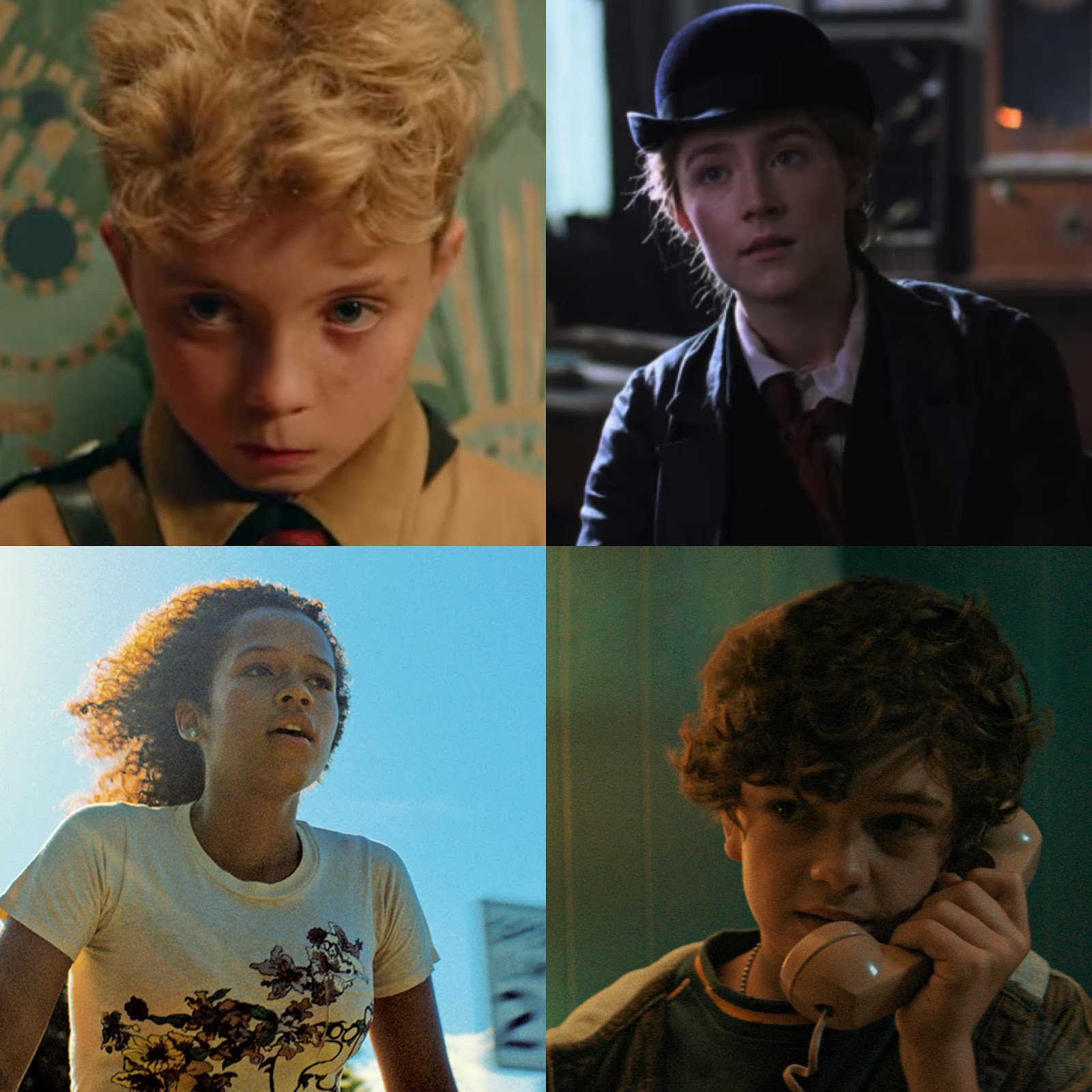
Roman Griffin Davis, Jojo Rabbit; Saoirse Ronan, Little Women
Taylor Russell, Waves; Noah Jupe, Honey Boy
Now I'm always just a sucker for child/young adult POVs in films which I think gives directors, and for that matter actors, an additional challenge to really bring you into that very particular perspective, and when it pays off it pays off marvellously. Well here's an enviable quartet of great performances this year by some young and very, very talented actors.
Now a 4-time Oscar nominee at the age of 25, Saoirse Ronan gives a marvellous turn as Jo March in Little Women with a portrayal that is equal parts a wonderful anchor to the film, and is not just an amazing performance for someone of her age but just an amazing performance, period. Her and Greta Gerwig are clearly the next undeniable pairing as she flourishes so well with the energetic, dynamic and earnest energy of the film and hitting the comedic and dramatic beats equally well, with special mention to how well she can go from goofy bookworm to snarky deadpan depending on the needs of the scene, absolutely delivering on the conflict between her desire for independence and desire for love, and honestly has such great chemistry with literally every cast member, particularly the other sisters. She never simplifies any of these relationships, nor that with Chalamet's Laurie, and creates a complex dynamic with each family member and acquaintance that amplifies the already great material and co-stars, and showing that she's truly in my opinion the best actress working today.
Another marvellous balancing act of tones can be found in Jojo Rabbit with Roman Griffin Davis as the titular character. It's hard to believe that this is Davis' acting debut as ten year old Johannes Betzler, young German in the later stages of WWII. It would have been easy for Davis' performance to get overshadowed by the likes of imaginary Hitler and wacky idiotic Nazis, but he gives such an assured portrayal of the effect of the jingoistic propaganda on his rude and stuck up antics, yet still somehow quite charming and endearing chap, and most importantly is consistently hilarious in each and every interaction. As the film progresses and gets darker he changes with the tone so brilliantly, culminating in the most heartbreaking scene of the year which is all about his amazing portrayal, and creates the transition of his character so vividly while never losing sight of his character as a young child.
Now Taylor Russell in Waves and Noah Jupe in Honey Boy give performances that are not as honed in upon by the nature of their respective films, but both give astonishing turns all the same. Russell carrying the second half of Waves, which I will admit I do have a few reservations about but which ended up hitting me in the emotional sweet spot all the same. In the first half she's really strong anyway, and her portrayal of recovery from grief and acceptance of the tragedy of the first half is amazing, her scene with Sterling K. Brown is one of the best acted scenes of the year, period, by both actors. And Jupe is a revelation as essentially young Shia LaBeouf in Honey Boy, playing the child actor side of the performance incredibly well, nailing each and every emotionally complex interaction with his onscreen father LaBeouf (who as I've mentioned before is great), and gives a consistently on point performance at every point in showing the painful experiences that wear on the young boy.
Kelvin Harrison Jr., Waves and Luce
Paul Walter Hauser, Richard Jewell; Matthias Schoenaerts, The Mustang
These three performances are all about watching as the gears kick into motion and you watch the inner life of the character in action.
In the case of Kelvin Harrison Jr. in Luce and Waves, and Paul Walter Hauser in Richard Jewell the gradual implosion is what make their performances click. Harrison Jr. gives quite the banner year of performances for his two terrific performances, both as star students and athletes who get thrown into rather troubling situations. With Luce he gives a complex, clockwork mystery of a charismatic, ambiguously manipulative figure thrown against the more intimate side that unravels as the film digs deeper into the core of the racial pressures thrust upon him, while in Waves he gives a more emotionally potent portrayal of a kid going through all manner of nightmarish scenarios as his dreams are crushed, giving a harrowing portrayal of the result of a series of terrible decisions. It doesn't matter that he's only really featured in the first half of the film as he leaves a lingering impression on you long after.Walter Hauser as the titular hero turned victim of press vilification gives another ticking time bomb performance as he firstly plays into his usual oafish self, though more endearing this time around, and depicts the overwhelming rise to fame and the crushing descent into becoming demonised by the press so vividly, maintaining a consistency in his Jewell's earnest desire to help matters that makes the implosion of righteous indignation all the more satisfying to watch.
Matthias Schoenaerts in The Mustang on the other hand gives a performance of defusion. Schoenaerts is as expected by now, terrific, at first giving very much in his usual wheelhouse of quiet brutish prisoner, yet what I loved and what I initially overlooked about the performance is how much nuance he finds in his character's transformation. It's so interesting to watch his character become more tamed down and opened up through his interactions with the horses he takes care of and reveals the character's vulnerabilities beautifully, and his breakdown sequences are not only extremely powerful but so well earned.
Robert De Niro, The Irishman; Antonio Banderas, Pain and Glory
Awkwafina, The Farewell; Ana De Armas, Knives Out
Now here's a quartet of particularly quiet, understated and observant turns that 2019 gifted us.
It would be remiss to not acknowledge that although I have some qualms about this year's Oscar nominations, it's great that Antonio Banderas' quietly emotional performance as essentially director Pedro Almodovar in Pain and Glory was nominated. It's one of the quietest performances ever nominated for an Academy Award, up there with Gary Oldman in Tinker Tailor Soldier Spy and I'm glad it was recognised. In that Banderas, in general such a lively, charismatic and larger than life figure, here disappears into the quiet, retiring and rather internalised sort that 'Salvador Mallo' is. He's strong throughout and is downright brilliant in the scenes where he reconnects with a past lover, where his restrained approach honestly made them hit with even more emotion than if he'd gone more overt.
He was rightfully awarded, unfortunately the same cannot be said for Robert De Niro in The Irishman and Awkwafina in The Farewell, the former despite being in a Best Picture nominee and one the Academy clearly loved, the latter despite winning the Golden Globe for Best Actress (Musical or Comedy). De Niro gives a true return to form after a series of increasingly awful films and roles, and though it takes a little while to get adjusted to the various ages of Frank Sheeran, soon enough he makes himself right at home with Scorsese's style. Though his role is in many ways more understated and less showy than his co-stars Pacino and Pesci, he plays off of each of them so well while making his almost passive, workmanlike character stand out with that De Niro screen presence, and then is legitimately amazing in the final act of the film in Sheeran's most elderly infirm state. Meanwhile, Awkwafina gives a complete 180 from her entertaining Crazy Rich Asians performance as Billi, who acts as the film's quiet wavering pendulum between West and East as she observes the 'lie' being told to her grandmother about her cancer diagnosis. Her performance is so quietly reflected of the changes and complexities within this predicament and dilemma and she really brings you into the experience every step of the way, and her 'big' scene of breaking down over her childhood is well earned and most importantly, splendidly performed.
Lastly, Ana de Armas in Knives Out is absolutely wonderful in a role which would in most films be a stick in the mud, luckily Rian Johnson makes sure that she's an essential cog to the film's success as essentially the protagonist, and an active participant and observer to the mystery at hand. She delivers entirely in the dramatic stakes, with so much of the burden of that side of the film on her shoulders, and beyond that also manages to get some laughs in which is pretty amazing given the nature of her character.
Lupita Nyong'o, Us
Florence Pugh, Midsommar; Samara Weaving, Ready or Not
It has to be said that this was a great year for the well-worn trope of the 'final girl standing' horror trope - Lupita Nyong'o in Us giving equal parts a vividly terrified and terrifying performance that pushes through the film's faults to deliver an astonishing dual performance, and Samara Weaving in Ready or Not and Florence Pugh in Midsommar granting such visceral, on point portrayals of young ladies finding themselves in, suffice to say, rather precarious relationships that lead to some truly gruesome sequences.
All three actresses are completely on point the whole time in delivering on the nerve-wracking fear and pains they go through. Pugh's unforgettable scream at the opening haunting revelation for college student Dani that simply escalates across the film in such an unassuming way, leading to that final unforgettable reaction shot. Weaving selling the hell out of every wound, crash and burn newlywed Grace has to endure on her tumultuous wedding night, and getting some surprising laughs in the process as she creates a convincing transition into essentially the action hero of the piece.
And of course, Nyong'o so mesmerising in both sides of her performance. Obviously protagonist Adelaide's complete and utter horror-struck phases as she takes in and endures all manner of creepy doppelgängers assaulting her family, but also as her own doppelgänger 'Red' which is simply an amazing creation by Nyong'o, creating an unforgettable horror monster with that raspy voice, those haunting eyes but also just how haunted, pained and emotionally unhinged 'Red' is that grants so much depth than perhaps the film even expected. It's just very entertaining and lively work that also manages to grant so much depth to the horror genre, and while I do have reservations with Us Nyong'o undoubtedly gives a phenomenal performance as both the hunter and the haunted.
Aisling Franciosi, The Nightingale; Adam Sandler, Uncut Gems
Aaron Paul, El Camino; George MacKay, 1917
And meanwhile if you want to be kept on edge, these following four performances keep you with their performances the whole time in taking their characters through the wringer, and creating an unsettling, anxious, constantly tense atmosphere as you follow them through every second of their absolutely riveting performances.
You've got Aaron Paul returning to Jesse Pinkman in El Camino to continue his character's arc from the series. Now I am still of the belief that the way Jesse's arc ended in the original series was perfect but nevertheless, El Camino was a great epilogue for the character. Whether it's playing through the early season 1 and 2 phases of Jesse, or the more haunted Jesse of the later seasons he's terrific, and earns the moments of levity and badassery along the way in the main meat of his work showing a man who's gone through hell and back, and it's really quite amazing how well he creates each phase of Jesse into a stellar conclusion.
Meanwhile, you've got Aisling Franciosi in The Nightingale giving an atypical revenge tale an atypical revenge protagonist. Like Paul's Pinkman, Franciosi's Clare goes through horrible, torturous treatment by some rather nasty sorts. Her performance is one that starts with relative simplicity in portraying her character as very much a jaded and flawed prisoner who's lived a harsh life which all then collapses as the nastiest and most repulsive means of revenge are exacted against her and her family. She never makes the subsequent journey into an avenging angel easy, showing the difficulty with which she goes through each action and makes it all the more powerful and brutal with each sequence as we see someone who's gone through hell become more and more jaded to it.
Where both the aforementioned characters were victims of others' perpetration, Adam Sandler's Howard in Uncut Gems very much creates his own problems as he goes along. This performance does something very special which the great Mark Kermode brought up, which is you don't need to like or even sympathise with this character to become invested in the film. He is a horrible person, and so compelling in many ways both because, and despite that. Howard is another Safdie brothers fuckup, a huckster jeweller who lives life on the edge, sleazily gambling and losing and gambling with others' welfare. Yet you can't wait to see how he'll mess up next and get out of the sticky situation. He makes pawning jewellery so invigorating to watch in just the cadence and rhythm with which Howard uses any means to get what he wants. His typical dorky Sandler-isms are used to darkly comedic effect particularly against Idina Menzel, showing a different side to his comedic talents. Him essentially 'selling' his life philosophy to Kevin Garnett is a truly mesmerising scene, as is him rooting for an NBA game which is quite something. His chemistry with Julia Fox is great, while also showing that no one can quite do a breakdown scene like Adam Sandler does when under the right direction.
Meanwhile on an almost opposite spectrum of characters comes George MacKay's Schofield in 1917 carrying the film's continuous shot premise on his shoulders through the horrors of WWI. Where Howard is a richly drawn character with a whole lot of mess going on in his personal life, Schofield is a pretty minimalist character in many regards with a thinly outlined backstory not overly dwelt upon by the film, lacking typical 'tropes' of a war film protagonist. This might seem I'm being critical, but I'm not. As in MacKay gives an utterly realistic portrayal of a young man snatched right out of WWI, giving an unfussy and utterly captivating portrayal of an everyman going through the horrors of war. MacKay is on point every second of his performance and is essential to keeping the various paces and varying intensities of the film moving. The film never stops to let him show off yet he manages to give one of the most affecting arcs in 2019 as almost silently, and so much said in his eyes, we see a hardened cynical man go through the horrors of war, break down again and again and yet keep moving. It's work that the more I think about, the more I love, and that 'Sixteen Hundred Men' scene, while a highlight for Sam Mendes, Roger Deakins and Thomas Newman, is also a masterclass in acting by MacKay as he silently shows a broken man so powerfully finding the will to make one last push.
Robert Pattinson and Willem Dafoe, The LighthouseAdèle Haenel and Noémie Merlant, Portrait of a Lady on Fire
Sticking one on an island is always good fuel for a narrative: see Robinson Crusoe, Cast Away. Stick two of 'em and what'll happen? Well all bets are off. You could get the nightmarish Gothic pairing of Willem Dafoe and Robert Pattinson in The Lighthouse or the eloquent, restrained romance blossoming fromAdèle Haenel and Noémie Merlant in Portrait of a Lady on Fire. Both pairings are dynamite pairings yet in such different ways, as Dafoe and Pattinson create such terse animosity that brings them together and tears them apart in isolation - the crusty old lighthouse keeper Wake and mysterious drifter newbie Winslow -, while Haenel and Merlant as aristocrat Heloise and painter Marianne slowly create a bond from their initial divergence and wariness of one another in this tale of a fateful art commission.
What really makes both pairs of performances work is how well they work in alignment with one another, but in such different ways. Celine Sciamma's direction and screenplay gives Haenel and Merlant the perfect platform to create this quite unassuming passion that blossoms between them, as they move from being on such different wavelengths, to still being on different wavelengths but with a connective tissue between them that is for lack of a better word, electrifying. Merlant so quiet and gradual in making her repressed character's feelings felt and Haenel an absolute powerhouse in showing her character's defensive attitudes subside into something else altogether, and I love how both performances build up the romance in such an organic way that always feels earned and never feels boring, and with special note to Haenel's final scene which is one of the best endings of the year and one of the best acted sequences of the year.
I've made no secret of my affection for The Lighthouse but for all my love for its direction, screenplay, cinematography, sound design, and really all the technical elements, the element that has stuck with me the most are the lead performances. They are magnificent showcases for each actor's talents as they're both so incredibly entertaining in the role yet also so layered, as they create a batshit crazy dynamic that just escalates over the course of the film into two performances that are as complimentary of one another as they are standouts on their own. Dafoe has never been better, pure perfection from that roguish, gruff growling West Country man of the sea accent, to the drunken decay and coarseness through every movement he makes, every fart he takes, and every biting remark he hurls to show Winslow as almost on a whole other level of being, but not a nice level of being, and Dafoe's screen presence is brilliantly used as a man who might be bonkers or might be completely sane, but is undeniably a powerful presence of being...unless you insult his cooking. What takes it up a notch is how it plays off Pattinson's bonkers, unwieldy (and brilliantly so) so performance where his wavering New England accent, the uncertain and haphazard way he moves his limbs, goes about his duties, performs heinous crimes against aviation and spits out some of the most memorable gems of insults, becoming just as terrifying in defying the avian gods with a good walloping as he is hilarious in lusting over a steak in more ways than one. Which incidentally is part of the best acted scene of the year (which I've enclosed of course) where Winslow insults Wake's lobster. Wake's genuine sincere sadness at this insult to Winslow's disdainful belligerence, matched by Wake hurling Promethean insults right back at him in a mesmerisingly delivered monologue, and the way the two bounce off one another in this scene encapsulates everything that's great about their every scene: hilarious, ferocious, oddly endearing, strangely moving, terrifying, endlessly mesmerising in this chaotic, marvellously frenzied relationship.
August Diehl and Valerie Pächner, A Hidden Life Scarlett Johansson and Adam Driver, Marriage Story
Now I should note that with regards to portrayals of marriage in 2019, Only You features two wonderful performances from Josh O'Connor and Laia Costa as a couple trying to conceive, and I would have reviewed them both here if I hadn't only watched the film so recently and hadn't enough time, and I unfortunately (still kicking myself for missing on it) missed my opportunity to watch Ordinary Love back in December due to a busy schedule, which by all accounts features excellent work by both Leslie Manville and Liam Neeson. Anyway, I digress. Adam Driver and Scarlett Johansson as Charlie and Nicole in Marriage Story andAugust Diehl and Valerie Pächner as Franz and Franziska in A Hidden Life give two powerful depictions of adversity conflicting with marriage. The former in Noah Baumbach's semi-autobiographical depiction of the dissolution of a marriage that threatens to tear their lives apart in the subsequent battle for custody of their son, Henry. The latter in the real life story of Franz Jägerstätter who as an Austrian conscientious objector was executed for refusing to take the Hitler oath.Both films are emotionally draining experiences, and a comparison actually can be made by their use of letters as a way of conveying the emotional complexities of both relationships, where the opening of Marriage Story conveys so well through the letters 'What I Love About Nicole' and 'What I Love About Charlie' to suggest the longstanding relationship betweenthe two and A Hidden Life in particular using letters exchanged and convey so much contrast between the characters' inner turmoil and their love for one another. On re-watch both films resonated all the harder knowing the direction their respective narratives will take.
For Driver and Johansson above all, a naturalistic depiction of a very realistic, long standing relationship that envelops and collapses on itself from essentially, a lack of communication on Nicole's behalf and a blend of ignorance and selfishness on Charlie's end. Now saying that is simplifying matters because one of the film's strengths is that it never pins the blame of the divorce on either side, with Johansson giving a very honest portrayal of her character's warmer and more quieter moments where she's trying to straighten things out, to her more bitter, angry moments at past regrets that she brings so much sincerity to with every moment, as does Driver who matches her with his excellent portrayal of Charlie being completely at loss and struggling to deal with the fallout, coupled with his stubborn belligerence at the requests made of him in the divorce proceedings, of which I particularly love his stress and anger when it comes to the prospect of having to make compromises when advised by his first lawyer (Alan Alda). I particularly love their depiction of the attempts at reconciliation throughout where they show such genuine warmth with one another that makes when it spirals into arguments all the more frustrating and genuine, whether its the 'serving papers' scene or whenever they come into conflict over spending time with Henry. It's hard to describe really what makes their performances click as much as they do, but both actors convey wonderfully the awkwardness, shame and in their big confrontation scene the outburst of emotions and frustrations in the spur of the moment where both are so powerful in their mutual breakdown, where the messiness of the divorce proceedings manifest themselves into a brilliantly acted sequence where both characters unleash on one another and Johansson and Driver give such a terrific display of unrestrained anger, hate and then shame. Both stand out on their own too in particular, Johansson in her breakdown to her lawyer (Laura Dern) and Driver when finally reading Nicole's 'letter' about him which are both absolutely heartbreaking scenes to watch.
Meanwhile, Diehl and Pächner have a different challenge altogether in the style of the film and their performances. In that they capture a very otherworldly sort of romance yetdo an amazing job in suggesting between Franz and Franziska an almost unspoken passion built upon years of love and hard work put into the relationship, and even in the voiceovers corresponding between one another are incredible bits of acting that build on this. The film resonates most when honing in on their powerful love for one another, with every glance and every touch, the way I'm describing it may sound cheesy but the way Diehl and Pächner depict is is anything but. Both actors are amazing both in showing the central conflict come between them, the rest of the world, and within themselves. Pächner is amazing in showing the strained yet unquestioned frustrations at her husband's actions, never making her love for her spouse an easy journey and showing the struggle in dealing with the animosity of fellow villagers who decry her husband as a traitor, and transitions it into an acceptance and resilience that's so powerful. She depicts so well the difficult position she is in, juxtaposing her almost ethereal emotional purity with her character's awful predicament that makes it even more powerful through her minimalist yet inspiring performance that will tear your heart part. Meanwhile Diehl has arguably the more limited role in some regards in that his character never seems to lose his resilience against submitting to Hitler, but he depicts that resilience so well, and makes the external turmoil his character goes through utterly heartbreaking as we see a man who's trying to do the right thing amidst it all. His character doesn't change, but part of the brilliance of that is he reflects so well the anguish and fear in doing so, and the scene where he breaks down and confesses that he wants to he cannot do something he sees as not 'right' even if it means is life, even if he wants to, because it's in his nature, an amazing scene that shows that Franz is not a godly martyr but a man trying to make sense of a terrible world. Both pairs of actors give astonishing performances and I really hate to have to not have all four in my leading lineups.
I struggled for the longest time in deciding who to leave out of my top 5 between Driver and Diehl, and honestly both deserve to, and in many ways I can see why one would put Diehl over Driver, Driver over Diehl, and in the end my reasoning for leaving Diehl came down to honestly his more limited role within the scope of the film as both performances really impacted me hard emotionally. I honestly prefer either of them just the same, and it only made things harder that Davis' performance was just as wonderful on re-watch and MacKay shot up the rankings after re-watch, and frankly any one of my numbers 2 to 6 are interchangeably even though my top spot is unquestioned. Maybe some point in the future I'll expand my nominations lineup because 5 is simply not enough for particularly strong years like this, and I should note that Actress was not easy at all either as I hated leaving Taylor Russell and Awkwafina out of the top 5! Although again, my winner was in the end a fairly easy choice.
Reel and Roll Awards: Best Actor 2019
Willem Dafoe and Robert Pattinson, The Lighthouse
Adam Sandler, Uncut Gems
George MacKay, 1917
Roman Griffin Davis, Jojo Rabbit
Adam Driver, Marriage Story
August Diehl, A Hidden Life
Robert De Niro, The Irishman
Leonardo DiCaprio, Once Upon a Time in Hollywood
Matthias Schoenaerts, The Mustang
Taron Egerton, Rocketman
Aaron Paul, El Camino
Antonio Banderas, Pain and Glory
Kelvin Harrison Jr., Waves
Bartosz Bielenia, Corpus Christi
Christian Bale, Ford v Ferrari
Anthony Hopkins, The Two Popes
Paul Walter Hauser, Richard Jewell
Josh O'Connor, Ordinary Love
Daniel Craig, Knives Out
Noah Jupe, Honey Boy
Kelvin Harrison Jr., Luce
Matthew Rhys, A Beautiful Day in the Neighbourhood
Jonathan Pryce, The Two Popes
Dean Charles-Chapman, 1917
Jack Lowden, Fighting with My Family
Daniel Kaluuya, Queen & Slim
Brad Pitt, Once Upon a Time in Hollywood
Eddie Murphy, Dolemite Is My Name
Zac Efron, Extremely Wicked, Shockingly Evil and Vile
Sam Rockwell, Richard Jewell
Shia LaBeouf, The Peanut Butter Falcon
Zac Gottsagen, The Peanut Butter Falcon
Joaquin Phoenix, Joker
Eddie Redmayne, The Aeronauts
Tom Hanks, Toy Story 4
Matt Damon, Ford v Ferrari
Adam Driver, The Dead Don't Die
Edward Norton, Motherless Brooklyn
Jacob Tremblay, Good Boys
Brad Pitt, Ad Astra
Adam Driver, The Report
Mena Massoud, Aladdin
Zachary Levi, Shazam!
Jimmie Fails, The Last Black Man in San Francisco
Timothée Chalamet, The King
Lucas Hedges, Honey Boy
Michael B. Jordan, Just Mercy
Brady Noon, Good Boys
Keith L. Williams, Good Boys
Bill Murray, The Dead Don't Die
Dwayne Johnson, Hobbs & Shaw
Jason Statham, Hobbs & Shaw
Dev Patel, Hotel Mumbai
Randall Park, Always Be My Maybe
Tom Holland, Spider-Man: Far From Home
Oscar Isaac, Triple Frontier
Himesh Patel, Yesterday
Jay Baruchel, How to Train Your Dragon: The Hidden World
Asher Angel, Shazam!
James McAvoy, Glass
Ryan Reynolds, Detective Pikachu
Justice Smith, Detective Pikachu
Ben Affleck, Triple Frontier
Chadwick Boseman, 21 Bridges
Tom Burke, The Souvenir
Samuel L. Jackson, Glass
Keanu Reeves, John Wick: Chapter 3
Matthew McConaughey, Serenity
Alexander England, Little Monsters
Donald Glover, The Lion King
Bruce Willis, Glass
Toby Sebastian, Trading Paint
John Travolta, Trading Paint
Devon Sawa, The Fanatic
John Travolta, The Fanatic
Reel and Roll Awards: Best Actress 2019
Saoirse Ronan, Little Women
Valerie Pächner, A Hidden Life
Scarlett Johansson, Marriage Story
Lupita Nyong'o, Us
Jessie Buckley, Wild Rose
Taylor Russell, Waves
Awkwafina, The Farewell
Adèle Haenel, Portrait of a Lady on Fire
Aisling Franciosi, The Nightingale
Ana de Armas, Knives Out
Samara Weaving, Ready or Not
Florence Pugh, Midsommar
Noémie Merlant, Portrait of a Lady on Fire
Laia Costa, Only You
Sienna Miller, American Woman
Felicity Jones, The Aeronauts
Constance Wu, Hustlers
Cynthia Erivo, Harriet
Renée Zellweger, Judy
Kaitlyn Dever, Booksmart
Florence Pugh, Fighting With My Family
Elizabeth Debicki, Vita and Virginia
Viktoria Miroshnichenko, Beanpole
Vasilisa Perelygina, Beanpole
Rose Byrne, I Am Mother
Lupita Nyong'o, Little Monsters
Honor Swinton-Byrne, The Souvenir
Naomi Watts, Luce
Daisy Ridley, The Rise of Skywalker
Jessica Rothe, Happy Death Day 2U
Beanie Feldstein, Booksmart
Charlize Theron, Bombshell
Octavia Spencer, Ma
Ali Wong, Always Be My Maybe
Clara Rugaard, I Am Mother
Brie Larson,Captain Marvel
Lily Collins, Extremely Wicked, Shockingly Evil and Vile