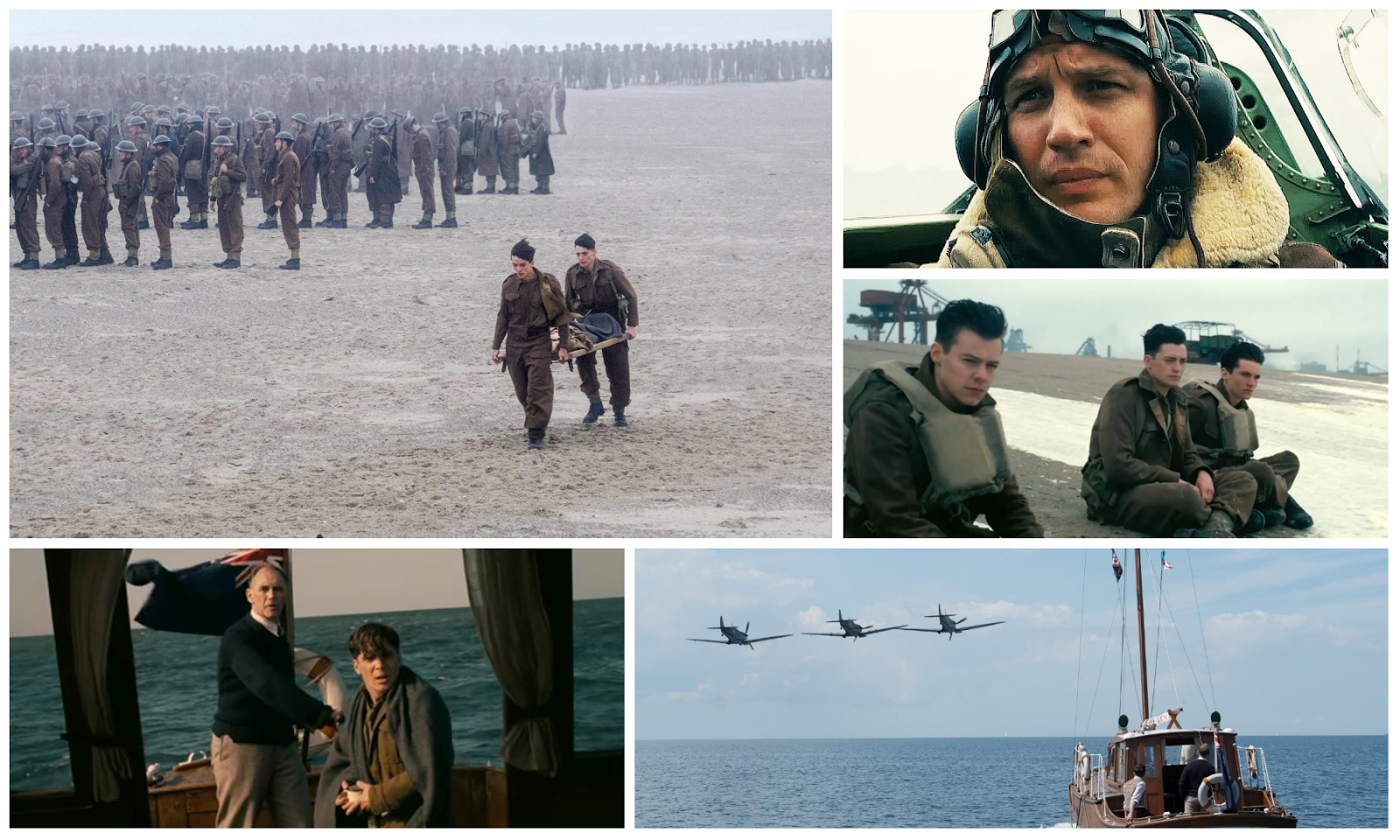
Much has been made of the narrative structure of Christopher Nolan's Dunkirk,which flits between three distinct time spans covering the WWII evacuation of Allied soldiers the seaside French town of Dunkirk. We see a week from the perspective of British private Tommy (newcomer Fionn Whitehead), a day on the seas with a civilian boat helmed by Mr Dawson (Mark Rylance), an hour in the skies with RAF pilot Farrier (Tom Hardy). It's not nearly as confusing as it might sound: in many ways this is Nolan's most pared down film, with a straightforward linear narrative driven with one unifying theme: survival. Which isn't to say Nolan's dialed down the ambition that's defined his filmmography: Dunkirk is an epic war film that thrusts you into the chaos of warfare, and refuses to relent until its final frame.
It is a very large-scale film - the 400,000 soldiers on the beaches, British, French and Dutch troops escaping the unseen German 'enemy' - and yet also a minimalist project. Dialogue is sparse throughout; the soldiers all have their own reasons for keeping mostly silent, and only speak when it's absolutely necessary. There's no Hardy wisecracks as he pursues enemy fighter pilots, and the young soldiers never stop to introduce themselves to one another, let alone delve into their backstories. Even discourse between the commanding officer (Kenneth Branagh) and the compassionate Colonel (James D'Arcy) is very to-the-point, explaining the outlines of Operation Dynamo's status to the audience briskly. The relatively more 'talkative' sequences in the film are on Mr Dawson's small boat sailing across the Channel, looking to rescue stranded British soldiers back home, but even then the interactions between characters are peppered with interludes of uncomfortable, disconcerting silence.
Nolan's intent here is not to create enigmas or mysteries, but to drive home the brisk, relentless intensity of war. There's no time to stop and grab your bearings. Yet though it's often times a wordless film, it is never a silent one thanks to Hans Zimmer's mesmerizing score. Almost an antithesis to his eloquent, haunting and melodic work on The Thin Red Line, the heart-pounding chords synthesized to an always-ticking clock creates that urgency for our characters to take action. When soundtrack and the terrific sound effects coalesce, as we are left helplessly watching brave young men struggle against the firepower of the enemy, and the forces of nature. Some of the most harrowing sequences in the film are set amidst the waters of the channel as the enemy repeatedly thwarts attempts to evacuate Allied soldiers. It's remarkably incisive work from not only director but cinematographer, Hoyte van Hoytema switching from the spacebound adventures of Interstellar to something far more gritty and down-to-earth.
It's not all just the bigger picture, though, and Nolan's sparsely dialogic screenplay does also ensure that we are presented with more than just faceless individuals among the chaos of war. There's an unspoken respect towards the men and women (many serving on the evacuation ships at the cost of their lives) in service without resorting to hackneyed glorification. Their heroism is handled in a very understated way by the script, and the emotional impact is thus amplified by the uniformly solid performances on hand. Rylance is fantastic as the wise and knowledgable mariner, and the scenes where he reasons with an unnamed shell-shocked soldier (a brief but haunting turn by Cillian Murphy) about returning to Dunkirk are extremely effective. Hardy, face largely obscured for most of his screentime, does a lot with very little thanks to his always-expressive pair of eyes, and of the young soldiers Jack Lowden (as Hardy's fellow RAF comrade), Aneurin Barnard (a quiet and low-ranking soldier), and Harry Styles (a cynical private) impress the most. Whitehead's protagonist is in some ways a character for the audience to project upon, an avatar into Dunkirk, but he delivers a solid performance and I hope to see more of his work in the future.
Dunkirk is not a flawless film, its final few minutes feel somewhat tonally at odds with the rest of the film, the few bits of exposition do feel a bit jarring, and the sound mixing is a bit off at points making the brief spurts of dialogue hard to decipher. Yet all these faults are tempered by a director whose strengths are often enough to compensate for his weaknesses. It is a fantastic example of minimalist storytelling merged with an epic scope, with thrills, chills and a glowing sense of respect for this story of survival against the odds. It refutes conventional notions of glory and instead honours the bravery of the soldiers. It may not be quite up there with Nolan's very best, but it's a terrific film nevertheless. Rating: 9/10
In my first installment of several articles discussing the fine art of Akira Kurosawa, I'll begin by focusing on his earliest works from the 1940s. Granted, I've yet to see them all, but for the timebeing let's focus on a few of them...
The earliest of Kurosawa's films I've seen and thus can thoroughly cover is One Wonderful Sunday, a very heartfelt love story set in postwar Japan. I wouldn't say it's an overly lighthearted film, so to speak, as it does deal with the central couple's (well played by Isao Numasaki and Chieko Nakakita) impoverished backgrounds, but it's certainly very whimsical and ultimately an upbeat celebration of life. It feels like a Jim Jarmusch film made way before his time, as nothing really 'happens' in terms of plot points. It's just a nice slice of life, well-directed by Kurosawa, not one of my personal favourites, but certainly worth a watch.
His breakout film was to come a year later, in the form of the terrific pseudo-gangster flick Drunken Angel. Like One Wonderful Sunday, it's a 'slice of life' film that's more about characters and interactions than the plot. Where other films might have chosen to focus on the higher echelons of the underworld, Kurosawa focuses on the lower depths, and within the grimy and unsparing world he creates develops the humanity of his characters. The titular character, Takashi Shimura's kind-hearted doctor Sanada, who struggles with alcoholism, is not your typical protagonist, and the charismatic but short-tempered hoodlum Matsunaga played inimitable Toshiro Mifune, in his first Kurosawa collaboration, is not your usual cinematic gangster either.
One of Kurosawa's most remarkable talents, evident so early on in his career, was the ability to create such compelling narratives without a conventional narrative structure. Drunken Angel, unlike most 'crime films' of the time, does not hold itself to a 'plot' so to speak. Matsunaga's onset of tuberculosis and Sanada's medical aid is paralleled alongside the former's struggle to leave the criminal underworld, and the latter's moral guidance, as well as Sanada's own confrontation with his past demons. The brilliance is that you never feel like these are characters going through the motions of a story where every action they make is a set up for another plot point. Rather, you truly feel like you're watching the struggles of two individuals that makes the film so powerfully resonant.
The two leads are great, with Mifune's bombast and energetic screen presence playing perfectly off Shimura's docile and timid characterization, and the supporting cast is uniformly solid in just conveying the good, the bad, and the ugly of Kurosawa's postwar society. And though the production values for this film would most certainly have been less than many of Kurosawa's subsequent works, the production design is every bit as atmospheric as any of his other films, the haunting cinematography is quite a treat particularly in the establishing shots, and most prominent is Kurosawa's use of sound. He's never afraid to let a scene 'linger'. There's a violent fight scene which goes on too long intentionally, conveying the mindless brutality of the gangster life; a dancefloor sequence (a Kurosawa trope) that keeps going on and on till it feels extremely uncomfortable, conveying the discomfort within the comforts of the gangster life.
Kurosawa would once again collaborate with Mifune and Shimura, utilizing them as a unique buddy cop duo of sorts in the excellent film noir Stray Dog. I wouldn't be surprised if this film inspired the dynamic central to Se7en as the camaraderie between the wise veteran and the inexperienced hotshot bears some resemblance (down to Shimura looking a bit like a Japanese Morgan Freeman), albeit with less intensity and with somewhat lower stakes. Mifune's Murukami, a rookie homicide detective, has lost his gun to a mysterious pickpocket, and it's up to him and wise and world-weary detective Satō to retrieve it.
Stray Dog is far more narrative-driven than Drunken Angel, and is also a much more cynical and darker film. It has its moments of levity, most notably through the dynamic between Murukami and Satō, but it is mostly a rather sombre affair, with every crime perpetrated and witness interviewed adding another layer of cynicism and darknessto the film.
The amazing cinematography, arguably the best out of Kurosawa's pre-60s input, has some fabulous money shots, like a uniquely framed interrogation in a hotel bathroom, a dazzling racecourse sequence filled a relentless pace that comes acros in the imagery, and the scene where our heroes come so close yet so far to catching the pickpocket, and we switch perspective from the hunters to the hunted's feet. The feverish heat of the detective's surroundings coarses through the film and adds so much to the atmosphere and overwhelming tension. Moreover, despite being largely a thriller, and an incredibly taut one, it also manages to have quite an emotional impact with its ending. The final showdown is minimalist and yet all the more memorable for that.
I should also note that The Quiet Duel is another Kurosawa film from this period. It's a solid character study of a doctor (well played by Toshiro Mifune) who becomes infected with AIDs, but I'd only really recommend it to anyone who's a big fan of Kurosawa. It's not a bad film, I don't know if he was capable of doing a bad film, but it does not stand out much beyond being an acting showcase for Mifune (and I prefer his performance in Stray Dog anyway).
Why? I'm not the biggest Wheatley fan, but he's a name that's bound to be bandied around in Bond discussions, and I think he could be a good fit for the position. My favourite film of his, Free FIre, was also probably his most mainstream film yet, which suggests that his quirky sensibilities may work best when (to an extent) there's some sort of studio control. Of course, his fans might see Bond as being a constraint on his creative capabilities, in which case he might not be the most popular choice. Regardless, his kinetic, visceral and occasionally quite gritty storytelling techniques may well bring something quite interesting to the genre, particularly if they're going to focus on Bond's more brutish side. He'll have a whole flock of Brit character actors supporting Craig, and I hope he'll find some way to play someone like Luke Evans or Michael Smiley opposite him, maybe as adversaries, or even friends.
Hypothetical Bond villain: Luke Evans as a mentally unstable mercenary, with Michael Smiley playing his more level-headed confidant and second-in-command. Hypothetical Bond girl: Michelle Dockery as a cynical contract killer who decides to play disorder and chaos in the MI5 to her advantage. Kathryn Bigelow
One of the most talented directors in the industry, Bigelow has a punch and viscreal edge to her films that's impossible to replicate in other hands, whether it's the endearing cheesiness of Point Break or the down-to-earth grittiness of The Hurt Locker. She showed in Zero Dark Thirty that she could mount tension and a government procedural like no other, and I think bringing that sort of vibe to the Bond films could be very interesting, though if they were to go in the more 'classic' Bond direction, I'm sure she'd also find some way to merge those elements with Craig's performance seamlessly. Hypothetical Bond villain: Paul Dano as a self-made millionaire and beloved public figure, who's been having government agents investigating his shady dealings murdered.
Hypothetical Bond girl: Ruth Negga as a seductive, wisecracking female spy equivalent to Bond who at first butts heads with him. Joe Carnahan
Carnahan's gone surprisingly under the radar considering how many somewhat notable Hollywood productions, from the (admittedly financially underperforming) The A-Team to The Grey, and his zanier smaller-scale productions like Smokin' Aces and Stretch. He's shown a flair for the vibrant and crazy in the latter, and a knack for nailing characterization and action in the former. Combined, I'd think he'd be a good choice for trying to appeal to both the audiences who like their Bond rough and coarse, and those who like him smooth and more light-hearted.
Hypothetical Bond villain: Chris Pine. In crazy mode. Period.
Hypothetical Bond girl: Chirs Pine. In crazy mode. Period. Michaël R. Roskam
Neither Tom Hardy nor Matthias Schoenaerts are playing Bond even though I'm sure both could do an amazing job of it, but their collaborator Roskam is a great candidate for directing the next installment. Roskam has showed a knack so far for exploring the seedy underworlds of both Belgium and Boston. He has such a knack for creating an atmosphere and tension in a confined environment, and I'd love to see how this skill translates to his depiction of Bond and the perhaps equally seedy world of the MI6. He has such a strange sort of elegance to his depiction of the brutal and the grimy, and that would fuse well into the world of Bond which is equal parts alluring and disturbing.
Hypothetical Bond villain: Schoenaerts playing a variation on the Robert Shaw, Dave Bautista type of 'brute enforcer', one of any nationality since there seems to be no accent Schoenaerts can't do.
Hypothetical Bond girl: Riley Keough as a deadbeat drug dealer who shares a past with Schoenaerts' villain. Anton Corbijn
A Most Wanted Man showed that he could portray the ugly side of espionage in a suitably downbeat yet effortlessly compelling way, The American showed that he could portray a career killer's downbeat life in such an uniquely beautiful, slow-burning way. He's clearly got it in him to make a Bond film, as he's got the style and panache, and understanding of the cutthroat fictional spy world, to create something out of 007.
Hypothetical Bond villain: Jean Dujardin as a very overtly sleazy but amiable Frenchman who is not all he seems, with perhaps Dane DeHaan by his side as a silent, remorseless henchman.
Hypothetical Bond girl: Any one of The American ladies could have made a great Bond girl methinks, but I'll go for someone like Elizabeth Debicki as a chilly associate of Dujardin's who's seeking a way out of his depraved world, and manages to manipulate Bond.
2017 has brought about two incredibly delightful crowd-pleasers so far in the form of Marvel Studio's Spider-Man: Homecoming and Netflix's Okja. In addition to being very enjoyable films, and in the latter's case carrying a great deal of emotional and intellectual depth, they're notable for having exceedingly diverse casts. Now diversity has been a topic raised repeatedly in the film industry in recent years, from awards ceremonies to casting 'quotas'. There are opinions to be had on both sides, but these two films recently utilized 'diverse' castings to put a positive spin of things, that may well appeal to both sides of the argument.
One side being that sometimes casting solely for diversity's sake harms a film. I never got that sort of vibe from Okja. I felt each and every character, even the ones that didn't work that effectively for me, had a specific purpose, and the multi-diverse nationalities of its cast, especially the ALF, enhanced them. K, played by Steven Yeun, is a Korean-American techie and translator for the team. His inadequate command of the Korean language is used for gags and a crucial plot point, but like Song Kang-ho's character in Snowpiercer, I always felt it added to the film rather than feeling forced. The choice to have a South Korean lead who speaks two lines of English throughout the whole film, too, never feels forced.
Bong Joon-ho is of course, Korean, and it certainly makes sense that having a protagonist from his homeland, in addition to featuring Seoul prominently, in an otherwise quite Hollywood production would be ideal for him. It may have been one of the factors which led to production companies being wary of his pitch, so credit to Netflix for not only granting him complete creative freedom and a substantial 60 M USD budget, but also allowing such international diversity, trusting in their director's ability to make it work cohesively with the story.
In Spider-Man: Homecoming, we have diversity amongst the cast, to the point that some have cynically criticized it of doing so to pander to the current film debate climate. I'd agree if not for the fact that everyone, and I mean pretty much everyone, in the cast is pretty perfectly cast. We have Hawaiian-American Jacob Batalon as Peter's best friend Ned, an expy of Ned Leeds in name only, and what I liked about the character is that they used him for comic relief, but never in a mean-spirited way that say, funny but problematic films like The Hangover are guilty of. Glad to see that we've come a long way from Breakfast in Tiffany's: all the laughs are garnered from his chemistry with Tom Holland's Peter Parker, and earnest and endearing little quips he makes throughout.
There's a budding interracial romance at the film's centre, and I liked that it was never once raised as an issue, or something out of the ordinary: it's just a usual high school romantic subplot. The film's ostensible MJ is played by the decidedly not redheaded Zendaya, and Flash Thompson is a Hispanic, stocky individual who's more of a jerk than a jock bully. Though these made for substantial departures from the Spider-Man mythos as I know it, I frankly did not mind all that much. The way their characters were integrated into the film was enjoyable and made sense for the tone of the film.
In conclusion, I'm not someone who advocates that every film needs to have a specific racial quota: for example, if you're filming a British prestige picture set in the 19th Century, there's nothing fishy about a predominantly Caucasian and well, British cast. And sometimes, if you just place an ethnically diverse set of characters and make them little more than minor plot points (looking at you Suicide Squad and Kong: Skull Island, where the Japanese characters are used little more than to provide weaponary), that's not diversity, not is implementing offensive, tonally-deaf racial stereotype upon racial sterotype into your movies (looking at you, Michael Bay). But when a film can integrate diversity alongside well-cast ensemble, than that's always a good thing.
27. Malekith (Christopher Ecclestone) - Thor: The Dark World
This is just an example of a really poor and uninspired Marvel film, and quite frankly the villain here is a perfect example of what many consider to be Marvel's Achilles heel: weak villains. Not in terms of their powers or abilities - Malekith is quite powerful, or so the film would have us believe - but in terms of aesthetic design, his motivations, it's all just so...boring. Even worse is when they try to insert the character into the usual Marvel quips and humour, making him feel even less threatening. Not Ecclestone's fault, he does his best with the character, but this is possibly one of the worst comic book villains in recent memory.
26. Aldrich Killian (Guy Pearce) - Iron Man 3
I don't mind this performance or this character before the reveal. Pearce as Killian makes for an effective ball of sleaze, as a sort of rags-to-riches counterpart to Tony Stark. Unfortunately when the third act revelations come around and Killian becomes the big bad, the character becomes an utterly ridiculous and nauseating example of what not to do with a villain. The whole idea behind Killian as this super-powered megalomaniac menace with vaguely defined powers is just awful, holds back an otherwise quite entertaining film, and don't get me started on how Guy Pearce should never be allowed to dial it up to eleven.
25. Ivan Vanko (Mickey Rourke) - Iron Man 2
In the briefest of comebacks, Rourke's bounce back into critical esteem as an actor was quite swiftly ended due to various factors which I won't go into here. It's interesting to note how a year before his performance in Iron Man 2 he also gave his career-best turn as the down-on-his luck The Wrestler which he should have won the Oscar for. Well, had this film been released a year earlier, this could've been his Norbit. Ivan Vanko is a character not without promise, an adversary to Stark with equivocal brains and smarts, and a somewhat sympathetic backstory. It's all wasted though on Rourke's ridiculously campy performance, although to be fair his accent sounds pretty good, and he has a few fun moments. It's odd that the better performance of his that year happened to be in The Expendables.
24. Nebula (Karen Gillan) - Guardians of the Galaxy
She worked much better as an antagonistic teammate to the Guardians in Vol. 2 but here she really makes for a particularly boring sort of villain. She's cold and delivers her lines coolly, she has some sort of fighting ability and can put herself back together when torn apart, but there's not much reason to be interested in her characterization.
23. Obadiah Stane (Jeff Bridges) - Iron Man
The Iron Man series has had such a mixed bag with villains, and I think the main problem has been not knowing how to utilize the actors involved. Jeff Bridges is one of the best actors working today, and the film wastes him in a hopelessly generic and predictable 'greedy right-hand man' role. He tries his best to make up for the shortcomings of the role, and actually is watchable in the role, but this still stands as a terrible waste of a great actor in a bad role. I'll grant though that there are moments where he does show flashes of potential, but that's all on Bridges and not the character or writing behind that character. 22. Johann Schmidt / Red Skull (Hugo Weaving) - Captain America: The First Avenger
Just a typical Nazi, eeevvvvvillll sort of villain. I mean, it kind of works for the pulpy feel of the film, and makes for a sort of intimidating adversary to Cap, but in the end he's one of the most forgettable elements of the film despite his appearance and his actions. 21. Ronan the Accuser (Lee Pace) - Guardians of the Galaxy
Now Pace is given one of the most thankless roles in a film that's otherwise peppered with so much joy and humour to play around in, in that he has to play the stoic and menacing, humourless villain for the most part. To his credit he does this aspect of the character well, like Bridges and Weaving, and what sets his performance and character slightly apart from theirs is Ronan's reactions to Peter Quill in his final scene. In a way the whole film builds up to his incredulous reactions in thatscene, and it's golden to watch. 20. Korath (Djimon Hounsou) - Guardians of the Galaxy
Korath too is a thankless role, but thankfully Hounsou's one of those actors who can bring menace and an intrinsic bit of fun to a role no matter what. I like his anti-chemistry of sorts with Peter Quill, and he does help set up a few of the film's best jokes, namely 'Star Lord' 'FINALLY' and 'finger to the throat means DEATH'. 19. Emil Blonsky/Abomination (Tim Roth) - The Incredible Hulk
It's funny how often people forget about this being a MCU film, which is understandable seeing as it was made in a time when Edward Norton was still Hulk/Bruce Banner, there's a noticeable lack of universe-building within it, and also the previous Hulk film had been made just about 5 to 6 years previously. Emil Blonsky is a curious villain in that he's actually far more menacing and interesting before he becomes the Abomination. Roth is always good at playing slimy villains, and this is another fine example of it till the abominable abomination of the Abomination, who alongside that weird thing in Batman v.s. Superman shows that sometimes, CGI produces laughable villains. 18. Dr. Armin Zola (Toby Jones) - Captain America: The First Avenger
Zola gets basically nothing to do throughout The First Avenger, but we have the great character actor Toby Jones playing him. There's a skeevy and Wormtail-ish quality to him that makes him quite an interesting villain to watch even with his scant screentime, and I kind of wish the universe utilized him a bit more beyond just a cameo in The Winter Soldier.
17. Dormammu - Doctor Strange
Doctor Strange isn't a perfect film, and there's lots you can nitpick about it, but I do love the climax which fittingly involves Benedict Cumberbatch's Doctor Strange using his brains over brawn to combat the big bad. Dormamu is an intriguing villain who the film doesn't really utilize fully, but his purpose in this scene is pretty clever, an example of Marvel making good use of a limited character. 16. Ayesha (Elizabeth Debicki) - Guardians of the Galaxy Vol. 2
Another flimsy villain and perhaps a bit too knowingly coasting on Debicki's elegant screen presence, but to the film's credit they utilize her properly, if not well enough. The pompousness of Ayesha and her stuck-up golden crew is entertaining and a welcome diversion, and though it doesn't add up to much, I imagine we'll be seeing a bit more of her in later films. 15. Ulysses Klaue (Andy Serkis) - Avengers: Age of Ultron
Can't wait to see this character have a bigger role in Black Panther. Serkis is always a guarantee of something interesting onscreen, whether as a mo-cap figure or in the flesh, and in a few minutes he makes for an entertainingly madcap, uncouth arms dealer. I'll reserve extended thoughts for when I inevitably cover Black Panther. 14. Brock Rumlow/Crossbones (Frank Grillo) - Captain America: The Winter Soldier and Civil War
One of the villains I'm most annoyed they gave the short shrift to, since I found Grillo's Rumlow to be a rather effective, Jon Bernthal-esque thug and bully sort in The Winter Soldier, and in his short screentime in Civil War to be one of the most incisive and chilling characters, at the centre of one of the film's most effective setpieces. I only wish they'd utilized him a bit more.
Though I loved how Civil War turned him into an important part of its heart and soul with his camaraderie with Steve Rogers, I did like how he was used as the titular villain here. A wordless but incredibly powerful nemesis, I thought Marvel did the best possible thing here with the character by making him stay away from all the quips and humour, and instead going all in with him as the cold and silent killer. The performance by Stan isn't anything special (he'd reach greater heights in Civil War), but the way the film taps into Bucky's history with Steve, and the Winter Soldier's plight, is very intelligent storytelling. 12. Taserface (Chris Sullivan) - Guardians of the Galaxy Vol. 2
I have a soft spot for this minor scumbag who causes nothing but trouble for Yondu (Michael Rooker, who I considered putting on the list, but Mary Poppins was never really a villain). Taserface is probably the least intimidating villain on this list because of his name, yes he manages to mutiny against Yondu but that's more through dumb luck than anything, but I love that the film acknowledges his character ineffectualness. He makes a despicable but also hilarious villain in his limited screentime, and I do love his final scene a great deal. 11. Ultron (James Spader) - Avengers: Age of Ultron
Though the portrayal of the character ended up being perhaps too comical, disappointing many who expected something more serious and chilling in the figure of the maniacal android, Ultron ended up being a decent enough villain, though far removed from the true potential of the character. James Spader's perfectly deadpan voice is perfectly cast with the delusional grandeur and self-assurnace of the titular villain, and even if the film and depiction of the character is a bit lacklustre, it does pack a bit of a punch.
10. Kaecilius (Mads Mikkelsen) - Doctor Strange
An example of a villain the writers didn't really give all that much thought or planning to, opting for a rather generic sort of villain down to the 'my family was murdered' backstory we've seen many a time before. That doesn't stop Kaecilius from being a pretty effective villain, and it's all down to Mads Mikkelsen, one of the most talented actors working today, who manages to be quite intimidating, but also rather humorous in his banterous interactions with Benedict Cumberbatch's Strange. And as some of the deleted scenes show, there was so much more potential for his character that was filmed. 9. Darren Cross / Yellowjacket(Corey Stoll) - Ant-Man
Fresh off House of Cards, Corey Stoll went from one of the most subtle, nuanced and heartbreaking portrayals of a political victim to a wry, sardonic egomaniac who's almost as self-aware as Frank Underwood. Darren Cross is perhaps the most indicative element of Edgar Wright's influence on the film, and one which perhaps somewhat clashes with the film's more breezy overall tone. The thing is, I've kind of grown to really adore the film, faults and all, and I think Stoll's approach to the role is very entertaining, albeit a bit jarring. Cross is an effective adversary to the understated charms of our hero Hank Pym, and Scott Lang, he's a hateable villain you want to see get his just desserts, and overall I just enjoyed this portrayal and writing of the character, even if it had perhaps just a bit more potential than was mined out of the role. 8. Trevor Slattery/The Mandarin (Ben Kingsley) - Iron Man 3
Like so much of Iron Man 3, an aspect of the film that half attains greatness, only to flounder with the final stretch. And to be fair, I do like the twist involving the Mandarin for the comedic payoff. Like so many Marvel films though, looking for laughs costs the film dearly in other regards, in this case the chance for a truly great villain. Up till that point, Kingsley's Mandarin is an insanely creepy, unnerving and deranged figure who seems like he might not only be a worthy match for Iron Man, but for all the Avengers if they were to use him again. When he's revealed to be just a hapless actor, it's quite hilarious, but afterwards leaves a gaping hole in the film, and we are left wanting for a satisfying conclusion, without a satisfying villain to finish things off. 7. Alexander Pierce (Robert Redford) - Captain America: The Winter Soldier
The Winter Soldier is in many ways a conspiracy thriller, and Redford's Alexander Pierce is one of the many enigmas at its centre. I really, really like this villain, as it's not the usual sort of grandstanding, power-hungry bad guy, more of just a man who thinks he's doing the right thing, in a very twisted way. The character gives the film an added degree of respectability as a worthy film in the genre of conspiracy thrillers, 6. Ego (Kurt Russell) - Guardians of the Galaxy Vol. 2
In hindsight, it was perhaps glaringly obvious that Kurt Russell was going to be playing the villain in Vol. 2. Regardless, I think the reveal was very well executed, the interviews etc. never gave anything away, and Russell was an extremely charismatic presence for the first half of the film, making his despicable revelations and actions in the second half all the more troubling and effective. I liked the twist on the usual motivations of villains to rule over the universe, as more of a displeasure and disappointment with it than a wish to conquer anything. 5. Justin Hammer (Sam Rockwell) - Iron Man 2
Rockwell Rockwell-ing it up as usual, and doing it better than anybody else. Though I wonder whether there was more to the character than just being a pain in the ass to Tony Stark, since as a shady arms dealer there's surely more dark material to be mined, he works just fine as a comedic side villain. He's by far the best part of the film, and I would not actually mind seeing more of Mr Hammer in the future. 4. Loki (Tom Hiddleston) - The Avengers
The period between 2011 - 2013 was one of arguably overexposure for Tom Hiddleston and Loki, to the extent that Hiddleston's subsequent cinematic work has been a bit underwhelming in that it's hard to see past him as Loki sometimes (a problem rectified by his sterling work in The Night Manager). Anyway, with that cast aside, despite being so prominently featured, Loki's still managed to be one of the most consistent elements of the MCU. He's worked well as both a pseudo-comrade like in Thor 2, or as a straightforward villain like in The Avengers, where he perfectly fulfils the role of the smug bastard you want to see get his just desserts. I do hope though that they'll find a different take to his character in Ragnorak. 3. Helmut Zemo (Daniel Brühl) - Captain America: Civil War
The most underpowered of all the Marvel villains, but the only one who's so far managed to successfully disassemble the Avengers. All at the hands of a footsoldier with vengeance on his mind. Zemo's not the most intimidating or imposing villain ever, and the film plays perfectly into this by having Zemo be such a sly, unassuming villain who unleashes his wrath in very small, subdued intervals. The character is taken on such an interesting journey from being a hateful villain to a surprisingly sympathetic one when the truth is revealed, and I hope Civil War wasn't the end of Zemo's story.
2. Adrian Toomes/Vulture (Michael Keaton) - Spider-Man: Homecoming
Just watched Homecoming today, and I'm really impressed with how director Jon Watts took one of my least favourite Spider-Man villains and made him into such a compelling figure. I really hope Keaton returns in the future to the role, as he absolutely kills it. Toomes' motivations are really well-sketched, he has a certain familial warmth to his villainy that's quite unnerving, and some third act revelations about his character, instead of hindering him, actually make him all the more menacing. There's one scene where Keaton, sans suit, creeps the hell out of the audience. A great villain, and he could very well rise to the top. 1. Loki (Tom Hiddleston) - Thor
Though I'm not a huge fan of the Thor films overall, I do love what they do with Loki in the first Thor film. They took a relatively unknown actor and gave him a role that seems ripe for one-note diabolical antics, but instead crafts such a heartbreaking villain, an adopted son who feels betrayed and estranged from his family, and whose motivations for being evil are so sympathetically drawn. He's the bad guy, undoubtedly, but there's a reason why some have considered Loki to be the true star of Thor's films: he's such an interesting and dynamic character. Once again, here's looking forward to what they do with him in Ragnorak.
This film is on the whole, easily the weakest of Edgar Wright's efforts I've seen, and I'll admit that most of his usual kinetic style and energetic editing is kind of nullified by the over-complicated storyline. Credits must go to this scene, however, for being a pretty affecting one. The whole film's dramatic undercurrent builds up to this revelation about what Gary King's deal is, while Simon Pegg and NickFrost's performances help make it a memorable moment. 10. Shaun's obliviousness - Shaun of the Dead
More effective in the context of the film than as a standalone scene, this is a terrific example of Wright's more understated side of his humour using the medium of film to perfection. Shaun's (Simon Pegg) utterly mundane routine contrasted with the ominous signs of a zombie apocalypse as he goes about his morning routine is comedy gold. 9. Scott goes on Amazon.ca - Scott Pilgrim v.s. the World
Small and short scene, but I love how much exposition Wright manages to get across with such brisk and sparse, and also very funny dialogue, and the transitions in this scene are particularly great. It also foreshadows one of the best jokes in the film in the first Evil Ex fight against Matthew Patel. 8. The interrogation of Simon Skinner
Could only find part of the scene online, but this is a golden sequence in the film where Nicholas Angel (Simon Pegg) feels like he's finally got ahold of Skinner only to quite hilariously fail, as Skinner quite deftly provides an alibi for everything. An ingeniusly conceived scene as we watch someone so obviously guilty 'prove' his innocence, and culminating in one of my favourite shots of Edgar Wright's, that of Timothy Dalton's double-shit-eating grin as he invites Angel to 'spool through'. 7. Shaun and Ed figure out how to kill zombies - Shaun of the Dead
Once again, such a fun scene that has jokes of both the slapstick variety (the sight of Shaun and Ed experimenting how to kill zombies) and of the more subtle sort (Shaun meekly suggesting that they'd better close the door, Ed's caustic comments on some of Shaun's record collection). 6. 'Don't Stop Me Now' - Shaun of the Dead
One of the last predominantly lighthearted scenes before the film becomes rather dark (the death of Barbara and Shaun's reaction features some fantastic acting on Simon Pegg's behalf), a welcome little respite of musical co-ordination with the visuals (which I'd imagine Baby Driver has in spades) plus some downright brilliant jokes like the line about killing the Queen. 5. Scott v.s. Todd - Scott Pilgrim v.s. The World
Everything about this scene is amazing. The sheer ridiculousness of everything from Todd's vegan powers to the sound editing, makes this an iconic scene, and it's probably the sequence most suited to Michael Cera's onscreen presence as Scott Pilgrim. 4. Discovering the truth about Sanford - Hot Fuzz
Testament to Edgar Wright's talent that what's in essence a typical 'villainous revelation' scene can have such a unique twist. First and foremost a great homage to The Wicker Man, hilariously ludicrous depiction of the lengths the Sanford community went to keep it the 'Best Village'. It's quite chilling while being quite darkly hilarious at the same time. 3. Scott v.s. Matthew - Scott Pilgrim v.s. the World
My favourite scene of the whole film, and a scene that's a bit underrated. Scott's fights against Lucas, and Roxy may contain the most laughs, the fight against the Katayanagi twins the most visual delights, and the fight against the final boss Gideon Graves may contain the most weight and stakes, but this first showdown contains so many delightful moments. The editing is perfect, the action is stellar, the wry asides from Wallace are terrific, and the way it sets the tone for the rest of the film is so exhilarating. 2. Raid on Somerfield - Hot Fuzz
1. Angel's return - Hot Fuzz
Not only is Hot Fuzz one of my favourite comedies of all-time, it's also one of my favourite action films of all-time. The whole film is a fantastic ride, but really it's the third act where it truly becomes a masterpiece. Edgar Wright goes all-in with all the foreshadowing he'd established beforehand with dialogue, visuals etc. and makes the return of Sergeant Nicholas Angel a pulse-pounding, riveting and witty scene.
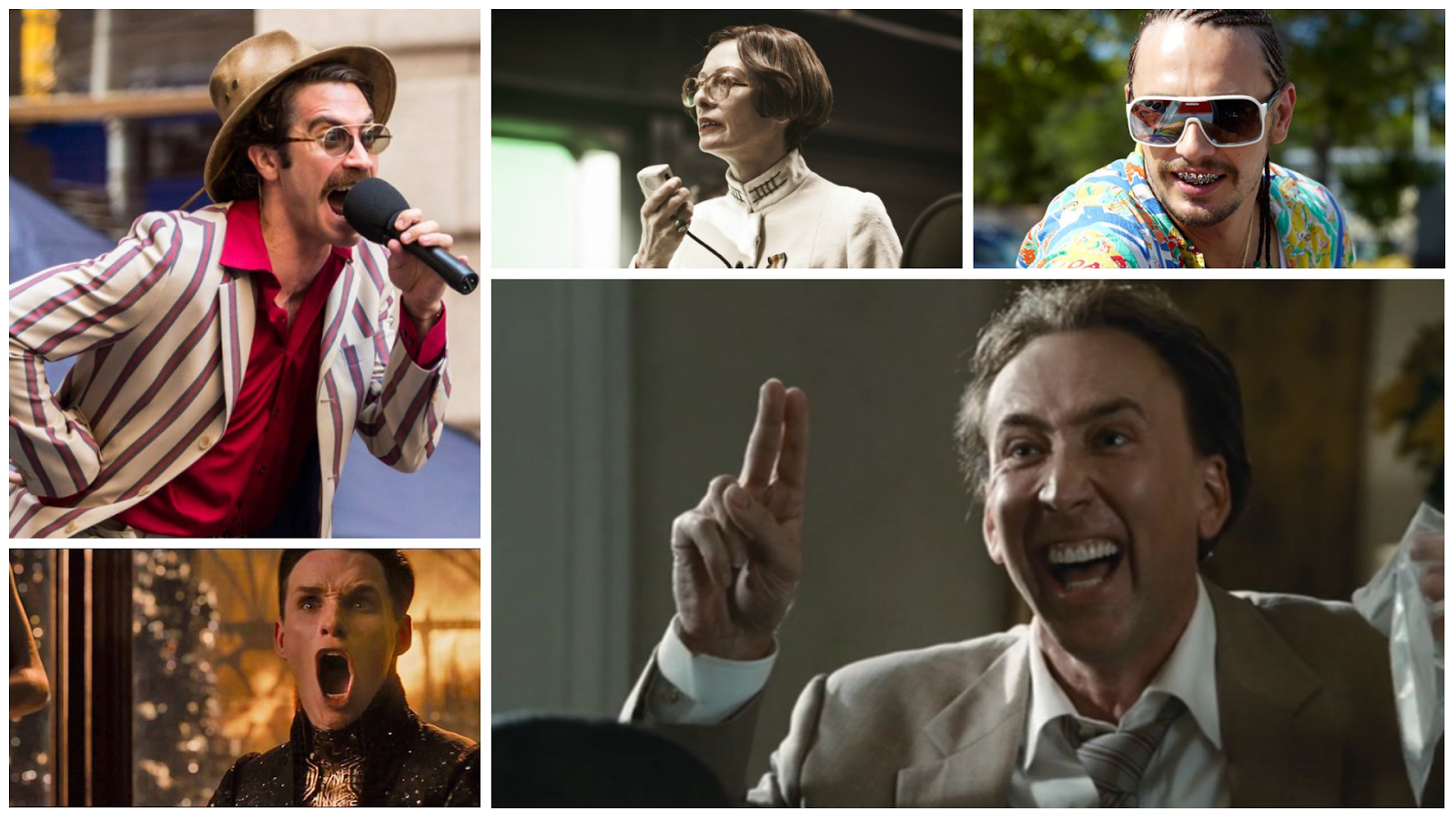
How was it a risk? For a film about a giant GM-modified pig, Bong Joon-ho's excellent action-adventure film features surprisingly subdued performances for the most part. The incredibly assured lead Ahn Seo-hyun, Paul Dano, Steven Yeun, Giancarlo Esposito, and all the other ensemble players give pretty down-to-earth portrayals of what their characters are going through, and then there's two performances at its centre which are wildly OTT. One is Tilda Swinton's double-act as the devious Mirando sisters which works extremely well. One is Jake Gyllenhaal's mad animal expert Dr. Jonny Wilcox. How over-the-top does he go? If you though Gyllenhaal was going out on a limb with Nightcrawler, you should see the extreme lengths he goes to try and steal scenes here. From his very first scene of screaming and moaning about a torturous mountain trek to his presentation of Okja to the public, he never dials it down. Does it work? In the words of Tilda Swinton's Lucy Mirando, 'epic fail' quite nicely surmises the effect Gyllenhaal's performance had on me. I like daring choices as much as any other film viewer, but only when they work out. Gyllenhaal's usually a guarantee of a good performance in my books, but this was just a really atrocious effort, in my opinion. I think Chris Pine, Sam Rockwell, and Paul Dano who's in the same film would have done a much better job with this whole routine.
Steve Carrell, Foxcatcher
How was it a risk? Everything Carrell does in this performance is a calculated risk. The real-life John du Pont was certainly a unique character, and Carrell just by taking on the role was taking a huge risk, considering how much of a pop culture staple/easily recognizable actor he is. How over-the-top does he go? The heavy breathing, the mumbly voice, the vacant eyes, the prosthetic nose, very little about this performance is subtle. It's a pretty broad performance for such a down-to-earth and coldly directed film that essentially deconstructs the usual 'sports movie mythos'. Does it work? Yes and no. It works in making John du Pont such a weird and off-putting character that contrasts with the Schultz brothers (Channing Tatum and Mark Ruffalo). But it also makes his actions always seem like that of a caricature, not a real movie character. Moreover, the best scenes involving du Pont in the film are Carrell's more subtle moments without the use of mannerisms.
Eddie Redmayne, Jupiter Ascending
How was it a risk? In the same year he gave an Oscar-winning performance in The Theory of Everything, Redmayne also set aside some time to do this science-fiction epic (disaster) and play one of the most unrepentant, campy, ludicrous villains both in terms of visual design and screenwriting. Balem Abrasax is a VILLAIN, and there's no scene that goes by without Redmayne doing something particularly EVIL.
How over-the-top does he go? The direction doesn't help him, but when contrasted with say, the utter lifelessness of Mila Kunis' performance, the horribly rendered CGI, or the forgettable supporting players, then Redmayne's already histrionic work reaches epic proportions of ham.
Does it work? You know what? I think this is a terrible performance by a good actor, like Gyllenhaal in Okja. But whereas that performance was a terrible one which threatened to hinder a great film, this was a bad performance in a bad film, and if I'm perfectly honest, I had way more fun watching Redmayne prance around screaming and making the most mind-numbingly weird facial expressions than anything surrounding the central romance. Redmayne himself graciously admitted in an interview that he deicded to throw it all into this performance, accepted his Razzie award with grace, and you know what I can respect that he tried to enliven an awful film, even if it was with an awful performance. Tilda Swinton and Alison Pill, Snowpiercer
How was it a risk? Bong Joon-ho, we meet again. Like Okja, this is another big ensemble film with one central, understated and very reactionary lead in Chris Evans, and a plethora of character actors of different nationalities to support him. Most of these performances, from John Hurt's weary mentor to Octavia Spencer's weary mother, to the insidious Big Bad Wilfred played by Ed Harris, the eager beaver sidekick played by Jamie Bell, and the cynical wisecracker played by Song Kang-ho, these are all fairly realistic and grounded characters played and written as such. Then you have two of the beroadest characters in the film, Tilda Swinton's demented Mason, a propoganda spokesperson who puts the passengers at the back of the train in their place, and Alison Pill's unpleasantly cheery schoolteacher.
How over-the-top do they go? Pill has one scene and it's one of the most heightened, surreal and downright disturbing sequences in the film, and her bug-eyed, creepy performance is crucial to that. Swinton is kind of the comedic relief for most of the film, and she certainly cuts a fine slice of ham and dishes it out to whoever she's onscreen with. Neither are very subtle performances...
Does it work? ...which work perfectly for how their characters are implemented into the film. Honestly, in the wrong hands or under the wrong direction these characters could have been just absurd, but instead by being so entertainingly off-putting they add so much to the dystopian atmosphere of the film. Sharlto Copley, Elysium
How was it a risk? From one acting extreme to the next, such was Copley's journey with his Neil Blomkamp collaborations. Having given such a subtle and poignant performance as an infected goverment bureaucrat in District 9, he turned it all on its head with his downright bonkers turn as Kruger, a crazy South African assassin in the flawed but still quite entertaining Elysium. It was a pretty daring move by Blomkamp to try Copley out in such a broad and OTT role when his previous collaboration was so focused on his talents as a more understated sort of performer.
How over-the-top does he go? He milks his beautiful accent for all its worth, plays essentially the walking embodiment of a vehement Internet troll, makes weird facial expressions, and the levelling up of his characters powers and abilities in the final act is fitting to the increasing ridiculousness of his performance.
Does it work? Hell yeah. The acting is probably the biggest flaw of this film, with most of the actors flailing around and being utterly bland (Diego Luna) or unbelievably wooden (Jodie Foster), and those who try to be entertaining mostly end up being a bit cringeworthy (Wagner Moura). Honestly the film would have panned out better as just a one-on-one battle between Matt Damon's Max and Kruger. James Franco, Spring Breakers
How was it a risk? The whole conception of the character, a rapper and gangster called Alien who begins a strange and twisted relationship with four teenage girls, is just very problematic at the outset, and indeed the whole film was quite a big risk that I, personally, never really felt worked out all that well.
How over-the-top does he go? Franco has two modes of performance essentially, one that relies more on his charm, one that relies more upon wackiness. This performance takes the latter approach and goes all-out assault on the senses with his whole attire, tattoos, sunglasses, pseudo-gangster mannerisms, and awful rapping.
Does it work? The film did not work for me whatsoever, nor did Franco's performance, but I would not call it a complete failure. A good version of this type of character can be found in True Romance in Gary Oldman's Drexl, but it's interesting to see him take on such a caricature, even if I do prefer his more naturalistic turns, and though it's mostly pretty cringeworthy and awful there are a few moments where he seems to be going somewhere with the character. Not a good performance in my opinion, but I can see the appeal for some. Joaquin Phoenix, The Master
How was it a risk? This whole performance is one of the most universally divisive, with some calling it one of the greatest of all-time and others calling it one of the worst Oscar nominees ever. Freddie Quell is a truly baffling creation, one Paul Thomas Anderson masterfully enshrouds in mystery and enigmas throughout the film.
How over-the-top does he go? You know what, in many ways this is a subtle performance in its own way, as the arc of Freddie is dealt with in a decidedly minimalist fashion, and there's plenty of scenes where Phoenix gives a very quiet and reserved portrayal of a troubled man. But when he goes loud, like in his various breakdown scenes and physical confrontations, and his dynamic with Philip Seymour Hoffman's mentor figure, he goes very loud.
Does it work? Oh yes. I may not love the film as most as many seem to (though I do like it a lot), but I cannot deny that it has an amazing performance at its centre. It's brave and utterly daring work that creates such a realistic and vivid portrayal of a broken man, and though he goes out on a limb with the whole character creation it never feels like 'acting'. Keira Knightley, A Dangerous Method
How was it a risk? In a film by David Cronenberg about the relationship between Freud and Jung, naturally there must be some wild cards thrown into the mix. Knightley's Sabina Spielrein, playing a patient who engages in a twisted professional and personal relationship with Michael Fassbender's Jung, portrays a patient suffering from hysteria, and has to merge an already difficult type of role with the strange, oddly distant tone that Cronenberg's direction creates.
How over-the-top does she go? Extremely. Forget the Keira from Pride and Prejudice and Pirates, this is a very different side to her from the usual British rose image she has.
Does it work? Not really. It's a performance that has its moments, a few seconds here and there where she nails the disordered and troubled condition of Sabina, but at other times it's a pretty disastrous performance. Like Franco, Knightley is an actress best suited to when she is a bit more 'natural' and doesn't try to actively ACT. Here, most moments of her performance feel very artificial and performed, and though the film around her isn't very good anyway she sinks it a bit further. I feel like someone like Eva Green could've really done a great job with this role. Nicholas Cage, Bad Lieutenant: Port of Call New Orleans
How was it a risk? The film features a scene where Nicolas Cage watches an iguana crawl acoess the room as the soul of a dead gangster breakdances into the afterlife. The whole film is a barmy, lopsided affair courtesy of Werner Herzog at his maddest, and Cage's performance is fittingly one which always takes the biggest risk possible since his character, the titular Bad Lieutenant, does nothing throughout the film but take unnecessary, outlandish risks.
How over-the-top does he go? People generally consider The Wicker Man to be Cage at his maddest and most manic, but I sincerely believe he goes even more outlandishly OTT here.
Does it work? It's a beautiful performance, I'd say a career-best by the fella, and it works because of how wholly Cage throws himself into the madness of his mad, bad lieutenant. Marcia Gay Harden, The Mist
How was it a risk? Religious zealots are both a very risky sort of character to play in a film, and also the sort of role which has become entrenched with certain cliches and tropes, so if one is to stand out as the character, one has to go a few steps further. Well Gay Harden certainly refuses to let her character be a quiet or unimpactful sort here.
How over-the-top does she go? Mrs Carmody is another one of Stephen King's infamous crazies, and Harden milks it for all it's worth. I'd say she at times seems like she's in an entirely different film from the otherwise rather sombre and gritty mood created by Frank Darabont here.
Does it work? Very much so. Carmody is meant to be somewhat at odds with everyone else and a true oddity, and Gay Harden is both campily entertaining in showing the complete ridiculousness of her character's way of beliefs, while also showing how eerily, how convincingly she can manipulate a flock of terrified people with her over-the-topness.