Note: in order to keep it fair, I've limited it to 1 film per director
Hon. Mentions: Reservoir Dogs, Raging Bull, Back to the Future, Satruday Night Fever, Miller's Crossing, The Girl with the Dragon Tattoo, Chariots of Fire, Run Lola Run, 2001: A Space Odyssey, Touch of Evil, Forrest Gump (yes, so sue me), To Kill a Mockingbird, Once Upon a Time in the West, Carol, Lawrence of Arabia, Raging Bull, any Bond film opening. If I counted Magnolia's opening character introductions as credits, it'd be right at the top of the list.
And I'll also be leaving off the credit sequences to the next two Halloween horror films I'll be covering on my countdown. Technically cheating a bit to get some of my other favourites onto the list, but they'd be right up there in my top 10 too.
Hon. Mention: The Graduate and its 1990s counterpart, Jackie Brown
I only left these two off the list because, firstly, one director one film limit, and secondly I can't decide which of these I love more. The Graduate perfectly paces the bored Benjamin Braddock's life to the tune of The Sound of Silence, and Jackie Brown struts her stuff to Across 110th Street with such aplomb. Both credit sequences immeidately capture your attention and captivate you to watch the film.
10. Se7en
Fincher's title sequences are always great even if the film is otherwise a bit lacklustre (see: The Girl With the Dragon Tattoo). The visual panache given to the opening credits of Se7en perfectly set us in this decrepit, downtrodden and deadbeat city we're about to enter, setting the tone perfectly. so credits to Kyle Cooper for devising the great hellish entrance into Fincher's magnus opus.
9. Requiem for a Dream
Harrowing without giving too much away in one go, Darren Afronsky's masterpiece remains so with every re-watch, and a lot of credit must go to the spellbinding opening sequence wherein we get a slice of life and slice of fantasy alongside each other.
8. For a Few Dollars More
Again, torn by this and any of the 'Dollars Trilogy' as they all have cracking openings, not to mention Once Upon a Time in the West which has one of the greatest credits buildups of all-time. I'll choose this one though because watching this for the first time, I was blown away by the cinematography, the simplicity, the music, the use of fonts, everything is perfect.
7. Fargo
Again, you could pick any number of Coen Brothers films to get onto this list, but I must say the opening to Fargo works for me just as well every time I see it. Exceptionally minimalist in the best possible way, Carter Burwell's beautiful soundtrack draws you into the snowy atmosphere of Fargo with such a chilling, serene air.
6. Raging Bull
Not the biggest fan of the film ever, but I do think it's a masterpiece in filmmaking in all technical regards. The opening sequence like Fargo's, is minimalist, but exceptionally effective, intertwining classical music with Robert De Niro's Jake LaMotta practising his punches in a misty boxing ring.
5. Watchmen
Hate putting a Zack Snyder film on one of my lists, but the opening credits to Watchmen are such a masterclass in stylistic choices, from one of Snyder's effective usages of sl-mo, and effortless exposition, plus the perfect addition of Bob Dylan's The Times They Are A Changin' that it was always inevitable the rest of the film couldn't live up to it that much. I don't hate the film, I think it's alright, but the opening credits are brilliant.
4. Vertigo
Hitchcock always liked his credit sequences, and you can see an interesting transition over his career from the more traditional title sequences of Rebecca and Foreign Correspondent, to the more stylistically innovative likes of Rear Window. Vertigo's Saul Bass designed opening is my favourite, iconic for a very good reason - it conveys and foreshadows the film in a subtle and enigmatic fashion, and even though the opening scenes of Vertigo are fairly straightforward, the dread from the credits sequence carries forth momentum.
3. The Hateful Eight
Pretty much every Tarantino film has a cracking opening sequence. Even something relatively minimalist like the Kill Bill openings and the one to Inglorious Basterds are memorable. Pulp Fiction has an unforgettable one that segues in the perfect fashion to 'Miserlou' and 'Jungle Boogie'. Django Unchained has an amazing throwback sequence that is so perfectly QT. My favourite though is his most recent one, which blends Morricone with some stunning snowy cinematography, gradually building up to a crescendo of tension that never relents through the film. Even if you don't like the film (and there are many dissenters), you have to admire this sequence.
2. Amadeus
An incredible opening sequence where we are thrown in medias res into the attempted suicide of Salieri. Cue Mozart's music being played over the credits. Adapting such a grand play to the silver screen must have been a huge challenge, and Milos Forman and co. did they right thing by stating from the very start, that this is why it deserves the cinematic treatment.
1. Drive
Easily my favourite opening title sequence of all-time. I've grown to love the film over time, more and more, but even when I merely liked it, that opening credits sequence set to 'Nightcall' has been one of my favourites of all-time. I actually think it might be my favourite scene in the film as it sets the dreamlike, yet gritty tones of the film in perfect alignment with one another. The use of different camera angles and perspective is incredible in placing us in the Driver's particular mindset, and watching it in parallel with the ending sequence makes it even more brilliant.
The Turn of the Screw is a novella I'd recommend everyone to read at some point in their lives. Ghost stories aren't my sort of thing in general, but Henry James' seminal Gothic tale of an unnamed governess who arrives at a mansion in Essex to help take care of two most unusual children, is as well-regarded and iconic as it is for a reason. It lingers on with you for days after reading it, and without going for cheap scares or easy answers crafts a palatably horrifying and yet intensely subtle tale of ambiguities.
Such a story is tough to bring to the silver screen; and thus the production team behind The Innocents tried to avoid this initial obstacle, perhaps, by choosing to adapt their screenplay more directly from the stage play of the same name, rather than the original source novella. They needn't have worried if that was the case. Jack Clayton's masterful 1960s horror never pigeonholes itself as either a gothic or psycholcial horror; it's a bit of both really, and Clayton and the film's screenwriters William Archibald and Truman Capote (!!) have a bit of a fun with both sides in bringing James' tale to life.
The film begins with one of the most beautiful, unnerving and minimalist credit sequences ever. Beginning with a blank, black screen with an overture of 'O Willow Waly', that somehow manages to unnerve with so very little, we technically begin in medias res but it is sort of obscured from our awareness; the theme to The Innocents by Georges Auric is both at once creepy and somewhat childlike and...innocent. It sets the tone perfectly and makes you want to watch on, even though the initial few scenes of The Innocents may seem like fairly standard sort of 'set up' for your typical horror film.
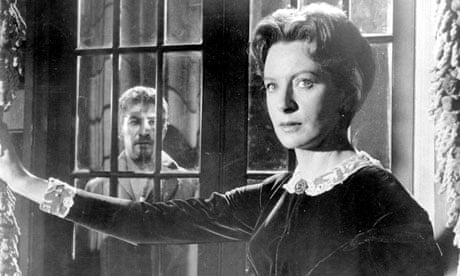
The unnamed narrator of The Turn of the Screw is given a name here, as well as one of the greatest actresses in film history, and my personal favourite actress of all-time, Deborah Kerr, to play her. Kerr was actually close to forty when filming The Innocents yet never feels miscast as the a character implied to be in her early twenties in the novel. Always the queen of expressive eyes and physically emotive states, Kerr makes Miss Giddens both a slightly more mature, more experienced figure than we've come to expect with similar sorts of characters, yet there's also a very childlike nervousness and rectitude to her. Kerr simply fits the role perfectly, bringing a very particular, old-fashioned style to her governess figure while blending it perfectly with a disposition more fitting to a timid, scared young girl, who's about to be plunged into an environment far beyond her control.
The orphaned nephews of the wealthy Uncle (a curiously tiny role for Michael Redgrave) she is sent to take care of in question, Miles (Martin Stephens) and Flora (Pamela Franklin), are not all that off-putting initially, nor are they meant to be. You're meant to see them first as just normal kids, Miles being the slightly more troublesome, and cheeky sort of lad, and Flora the more naturally endearing and sweet sort. Franklin's performance as Flora is one which draws appreciation from me upon every re-watch. She's very charming and makes you really enjoy every moment her jolly face and youthful exuberance permeates onscreen, which makes the subsequent revelations of the film all the more jarring; her breakdown scenes at the interrogations of Miss Giddens are incredible scenes, as Franklin shows an incredible amount of visceral power that would make most actresses that age crumble. She holds her own incredibly well in, far as I'm concerned, the greatest actress of old Hollywood, and that she was a mere 11 years old when this film was released is just amazing.
The subject of the interrogations is ghosts, of course, ghosts that are apparently haunting the estate, of the deceased, decadent valet Quint (Peter Wyngarde) and the previous governess Miss Jessel (Clytie Jessop). The handling of the supernatural elements is of course, subdued, extremely subtle, because like the source material, whether the ghosts are actually there, or whether they're the byproduct of Miss Giddens' twisted imagination, is never explicitly made clear even towards the harrowing end. The ambiguities could have fallen completely flat, but they don't on two accords. The screenplay never cheats and gives a fair and balanced possibility to both perspectives without compromising the effects of either the supernatural or psychological horror. And Kerr's performance, of course, balances perfectly the two sides of Miss Giddens, utterly compelling and convincing in her fear of the ghosts, and also suggesting a mental imbalance in the margins that would lend credence to the alternative interpretation of the character.
The direction of the film by Clayton manages to be at the same time, very much faithful to the Gothic elements of traditional supernatural horror films, while at the same time delivering some pretty nifty, subversive tricks of its own. I particularly love each of the 'lighter' scenes which still suggest a bit of creepiness underneath, like in the small moments where the housekeeper Mrs Grose (a wonderfully understated Megs Jenkins) tries to hide away the past with a cheery smile, or when Miles is being just a bit too flirtatious to Miss Giddens for a boy of his age. Then the scenes where the more conventional 'horror' beats come along, Clayton remains supreme in never choosing the easy way out in terms of 'jump scares'. The first appearance of Quint is one of the scariest scenes of all-time because of how unsuspectingly it draws up on you, and any of the scenes where Miss Giddens is investigating the grounds get marvelous 'scare' payoffs because of how Clayton twists your perceptions when exactly, and in what fashion the 'scares' are going to come round.
The lighting in the film is magnificent, and manages to make the nighttime scenes in the mansion (the use of illuminating candlelight being particularly effective) as suspenseful as the daytime sequences where we get iconic images like the hazy figure of 'Quint' on the tower top, or Miss Jessel standing by the reeds in the mansion's lake. Freddie Francis' cinematography is stunning as he captures such a particular sense of horror. Not that of the grotesque variety, necessarily, but of a terrifying beauty to be found in every corner of the household. You can't bear to look away since it's all so beautifully filmed, and at the same time the underlying horror of the screenplay and direction makes you fear every second.
The most controversial element of the film is perhaps the relationship between Miss Giddens and Miles, still extremely daring even when placed in a modern-day context. Stephens quit acting a few years after this to pursue a career in architecture. Whatever the reason (apparently the allure of acting had lost its appeal), certainly wasn't for lack of talent. He plays the iconic role of Miles perfectly, by like Kerr allowing ambiguities over whether he's truly the twisted, cruel child the boarding school which kicked him out suggests he is, or simply a frail young boy being possessed by some extremely terrifying ghouls. The handling of his controversial 'affection' for Miss Giddens, and vice versa, is extremely well handled by the film. It never feels in bad taste, and works within the film as a very serious reflection of how the selfish actions of Quint and Miss Jessel could have imprinted themselves terribly on the children. Even if you take the stance that the whole 'ghosts' element of the film is purely through Miss Giddens' mindset, the predicament of the children is still terrifying; orphaned, closed away in a mansion, with the ghosts, whether literal or figurative, of two twisted people haunting it.
Miss Giddens' determination to save the children culminates in a spellbinding final act where she sends Mrs Grose and a distraught Flora away. The subsequent 'showdown' is of a most curious sort. Unlike The Omen or The Exorcist, there is not something that MUST be done, no imperative action or obstacle that very clearly must be overcome to bring things back into balance. The crux of Miss Giddens' plan fits in perfectly well with her role as governess and teacher to Miles; she must make him confess to being 'naughty', to having misbehaved at school, to having conversed with ghosts, in order to set him free. Their back and forth dynamic in the final act starts off amiably enough over dinner and dessert, with Miss Giddens playing along with Miles' glib and cryptic comments before becoming more incisive and biting in her interrogations. The gradual descent of Miles from the confident, cheery child masking something to a swearing, obscene, manically laughing child with nothing to hide is terrifying, with Stephens and Kerr selling the scenes with their pitch-perfect reactions, and help make Henry James' amazing ending work. The film spends most of its duration being a masterclass in horror and suspense, but ends on an incredibly poignant, heartbreaking note that gradually builds itself up, and creeps onto you the whole way through.
Constructing a film around a twist, just a twist, and having everything else lead up to and stem from that, is an extremely difficult task that sets one up for failure. It takes someone like Alfred Hitchcock to nail it, and even then I still don't think Psycho is a flawless film. One factor for this is that twists are too often easily spoiled by the media; thus if a film is based around solely its twist, it runs the risk of falling completely flat.
I think a lot of people know the twist to Neil Jordan's The Crying Game by now (thanks in large part to Ace Ventura) - and even if you're watching the film for the first time with no previous knowledge, I'd say a lot of viewers could pick it out beforehand. I'm going to discuss it alongside the film because, frankly, I don't think knowing the mid-film twist does anything to hurt one's experience of the film; in fact, I think it enhances it. The point is that, unlike what you might've heard, The Crying Game is not all about the twist. It's about the journey that leads to and leads from the twist, alongside a lot of different plot elements and themes that may seem scattershot at first. The film is not dominated by the twist, nor should it be.
The film starts off quietly enough in rural Northern Ireland. A British soldier Jody (Forest Whitaker) is kidnapped by an IRA unit, and used as a hostage to demand the release of three jailed IRA members. In the initial stages, The Crying Game is not much of anything really, and I mean that in a good way. It's not quite a thriller, it's a rather subdued drama but nothing very dramatic happens, there's a bit of comedy but it's always undercut with a certain darkness, and it's all rather static in terms of location - the IRA members have holed themselves up with Jody for three days in a little cabin in the woods.
The tersely done interplay between the IRA terrorists is well done and well-acted, but where the film really starts coming into its own is in the relationship between hostage Jody and one of the IRA volunteers, Fergus (Stephen Rea). Rea's performance is one of the greatest understated performances of all-time, rightfully nominated for Best Actor even though some consider him the weak link of that lineup. There's something so utterly magnetic about his portrayal of Fergus despite the man being written as a bit of a non-entity to start with. The whole arc of the film is centred on his character's development, and we begin with him being a blank slate, a simple goon really, who just follows the IRA's orders without really giving much thought or passion to it. Rea does incredibly well to show that behind this dispassionate way of going through questionable motions, is a good man.
Jody and Fergus have a bit of rapport that starts of as queasy, good-natured animosity to something much deeper. There's one flaw to these scenes, and that's Whitaker's incredibly odd BritISH accent. And even that's really not all that distracting when you focus on the intrinsic power of these scenes together, which involves Jody gently probing through Fergus' defenses to find the humanity lingering within, and Fergus contemplating his position in life whilst interacting with the desperate, scared but also very charismatic and endearing Englishman. The screenplay's handling of their friendship is incredibly moving and powerful, and makes the swift, sudden exit of it, all the more jarring.
SPOILERS
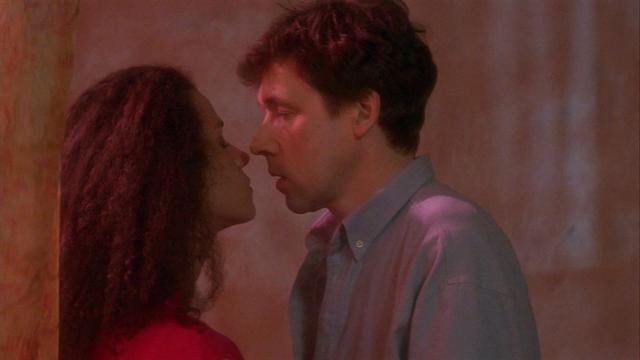
Fergus makes Jody a promise to visit his girlfriend Dil in London, which he does so after the cabin the IRA volunteers were hiding out in gets bombarded by British soldiers, and he goes AWOL. The twist to the film is that Dil, played by Jaye Davidson, is a trans woman. This apparently elicited many shocks at the time, and watching it again I can see why; it's hidden well by the film up to that point, although you can certainly tell if you're watching attentively enough that it is indeed a man playing a character that's set up to be 'female'. I won't get into too much detail about it all because frankly, I don't think the film's trying to make any overt statement about it.
The first scene where Dil and Fergus meet, by the way, is one of the best-written scenes in film history. Watch this.
Anyway, Dil being a trans woman, and Fergus falling for Dil, is not the dominant theme, just another component of The Crying Game which makes it one of my favourite films of all-time. He's a man who must firstly learn to confront how he was brought up, his whole way of life and thinking that the English are all evil. Well as he learns from Jody, some Englishman can be alright chaps, and the lot he hung out with back at home - best represented by Miranda Richardson's iconic, subtly terrifying performance as the seductive and reprehensible Jude - weren't all that great anyway. Then in Dil he's thrown yet another curveball to his way of thinking; how can he have been attracted to someone, when the whole idea behind Dil just goes against the conventional ways of thinking? Fergus starts off by being disgusted at himself for having been allured by Dil, but gradually he finds the better man within him to disregard that. It's not so much that he immediately develops the conventional sort of love for Dil, but rather a blend of a friend's affection with a lover's attraction.
Even till the final scene, we still see a slightly tentative side of Fergus to being attracted to Dil, but the great thing about the film is as well as developing the relationship effectively, it makes it rather heartwarming in evoking its themes of acceptance and equality with such remarkable subtlety. It's never thrown at us, Jordan just takes the film into a slightly different direction, and from a different perspective after the twist that really takes you aback and makes you think with each re-watch. What makes someone a good man? The film doesn't offer a definitive answer, but becoming more open and accepting is one of them - and acknowledging one's instincts and 'nature'.
The theme of human nature is set up earlier in the film in a story told by Jody to Fergus, about the scorpion and the frog:
“Scorpion wants to cross a river, but he can’t swim. Goes to the frog, who can, and asks for a ride. Frog says, ‘If I give you a ride on my back, you’ll go and sting me.’ Scorpion replies, ‘It would not be in my interest to sting you since as I’ll be on your back we both would drown.’ Frog thinks about this logic for a while and accepts the deal. Takes the scorpion on his back. Braves the waters. Halfway over feels a burning spear in his side and realizes the scorpion has stung him after all. And as they both sink beneath the waves the frog cries out, ‘Why did you sting me, Mr. Scorpion, for now we both will drown?’ Scorpion replies, ‘I can’t help it, it’s in my nature.’”
Fergus has been denying his nature by participating in the IRA, acting as a mindless mook, following the motions. When he finally takes life head on and tries to make a differece, he starts to act for himself, act in his nature.
The Crying Game is thus, all about a flawed man becoming a better man - but most importantly, within his nature. Fergus starts off as someone who'd probably bore your socks off at a social gathering; he seems to have nothing to him beyond his ability to take orders. When asked to tell a story, all he can muster is a Biblical quote - 'When I was a child, I thought as a child. But when I became a man, I put away childish things.' Dil and Jody, two people he'd have never have associated with in normal circumstances, help to bring out the best in him. He's haunted by the memory of Jody and having been so touched by his friendship with him, does his best to keep Dil safe, no matter what the cost. His hesitation to reveal that he'd been part of the IRA squad that effectively killed Jody is not because of fear of being found out; nor is his reluctance to helping the remaining IRA volunteers carry out an assassination due to cowardice. He's become a decent man who wants to do the decent thing.
I've spent most of my time talking about the thematic elements of The Crying Game, and not even all of them; beyond the emotional story of self-realization and the transgender dynamics, there's a bit of political elements regarding the Anglo-Irish relationship thrown in as well. But it's also extremely well-directed, the cinematography is ace, and the music is fantastic. The opening and ending songs - 'When a Man Loves a Woman' by Percy Sledge, and 'Stand By Your Man' by Lyle Lovett - act as perfect bookends to the film's message, and the titular song, sung by Boy George, forms the backdrop to one of the most deeply involving sequences in the film. It's a great film I feel deserves a lot more credit both for what it directly is, and its more subtler undercurrents. Watch it!!!!!
One reservation I did have with 2015's Spotlight was that it almost wholeheartedly embraced the notion of pretty much all the Roman Catholic priests in the Boston area being pedophiles. It was certainly a true story, and I give credit to them for sticking to the facts. But there's fact the whole Spotlight team, made up of atheists/agnostics, seemed so determined to discover the truth. It was obviously admirable in real life, and it's also admirable in the film. But the addition of their religious inclinations slightly undercut certain parts of it, in my opinion, into becoming a 'topple down the church' sort of deal.
A sign the times are a changing. In an increasingly secular society, and adding to that the fact that there's increasing number of incidents akin to that covered by the Spotlight team, means that in the media, overall, preists are getting a bad rep. Some of them certainly deserve it, undoubtedly, and it's terrifying and horrible to see how some abuse their power. But not all of them do. And truth be told, I think the negative portrayal of priests overwhelmingly nowadays does strike me as a bit much. Which is why I kind of appreciate a film like The Exorcist all the more for its positive portrayal of priests as not all-holy, all-mighty figures, but human beings with the will to do good.
We open the film with one of these priests, and the titular exorcist, Max von Sydow's Father Lankester Merrin. Watching the film for the first time, I was taken aback by the fact that this was a 1970s film, and yet ol' Max looked exactly like he does nowadays. That's testament to the fantastic makeup by Dick Smith, who did a similarly superlative job on F. Murray Abraham as old Salieri in Amadeus. It's just the tip of the iceberg in terms of the makeup effects in the film, but it combines with von Sydow's performance and William Peter Blatty's patient, nuanced screenplay to craft quite the subtle opening sequence where we get seamlessly delivered exposition about Pazuzu, the demon who will come to haunt the film.
The film takes a while to get going in the best possible way, as we're presented in Georgetown, Washington, with the simple life of an actress mother Chris (Ellen Burstyn) and her daughter Regan (Linda Blair). We're not immediately thrown into gloom and doom, the film's opening had sufficient gravitas to allow a bit of breathing room. There's a bit of broad comedy involving Chris' director, the quirky Burke Dennings (Jack MacGowran), and we get some insight into Chris and Regan as characters before things, so to speak, go to shit. It's an interesting dynamic in that there's nothing particularly overt in the film's direction to show it's a loving mother-daughter relationship, instead it's depicted in a realistic fashion, as is Chris' atheism; the film doesn't hit you over the head with either element. It's just there.
Regan becomes infected with the spirit of Pazuzu when playing with an Ouja board, and from that point on the film's direction slowly makes itself more and more evident. The creation of Regan/Pazuzu should of course be credited to Blair's performance of course, which is certainly crucial to the buildup of the character. The whole conception of the entity required to be exorcised though, is composed of several components. There's the raspy voice of renowned old Hollywood movie star Mercedes McCambridge, the face of Eileen Dietz as the demon, and of course the amazing special effects by Smith. They all contribute to the deeply unnerving experience that is watching Pazuzu wreck havoc in increasingly morbid fashion. The cinematography and editing in these scenes are also essential to their immersive power, but perhaps most impressive above all is the sound mixing, which really brings out the power of both the chilling soundtrack and the sound effects for the exorcised and the exorcism.
Regan's predicament brings into the fray, alongside von Sydow's Merrin, several other figures into Regan's life. One is Lee J. Cobb's police detective Kinderman. What I kind of love about the writing behind the role of Kinerman is that Blatty never makes him a fool even though the film's events are way out of his element. Kinerman acts as sort of the audience's avatar within the story, a levelheaded figure with a slighty cynical edge. I like how his character is utilized to interact with characters like Chris, who's increasingly emotional and poignant through Burstyn's fantastic performance. Cobb's performance is a breath of comedic relief and efficient exposition through the film.
Then there's the priests of Father Joseph Dyer (Father William O'Malley) who is the most straightforward, pious figure in the film; and Father Damien Karras (Jason Miller) who is suffering a crisis of faith after having lost his mother a few years previous. One of the most powerful elements of the film that put it above simply being a great scary horror is the emotional backdrop of Karras' journey. The whole duration of the film consists of him doubting his faith in God and being haunted by his past griefs. The growing realization of a man snapping out of his stupor and confronting the demon Pazuzu firstly with fear, then with anger, and finally with ultimate courage, is extremely powerful and makes the ending of The Exorcist work as well as it does.
There are films that strive for subtlety in what they're trying to do - I'll get onto one of those in a bit. Then there's films which make it extremely clear from the outset, what's the deal, what you're in for; that's the sort of film The Omen is. Make no mistake, from the first few minutes you have a very clear idea about what direction the film is going in as we have Jerry Goldsmith's fantastic score sending particularly resonant chills down my spine every time I sit through the film. In Rome, Katherine Thorn's (Lee Remick) child is stillborn, leading the hospital chaplain to implore her husband Robert (Gregory Peck) to secretly adopt an orphan in the stillborn child's place. Thus sets up one of the greatest horror films ever that's never subtle in intent, yet never ceases to shock.
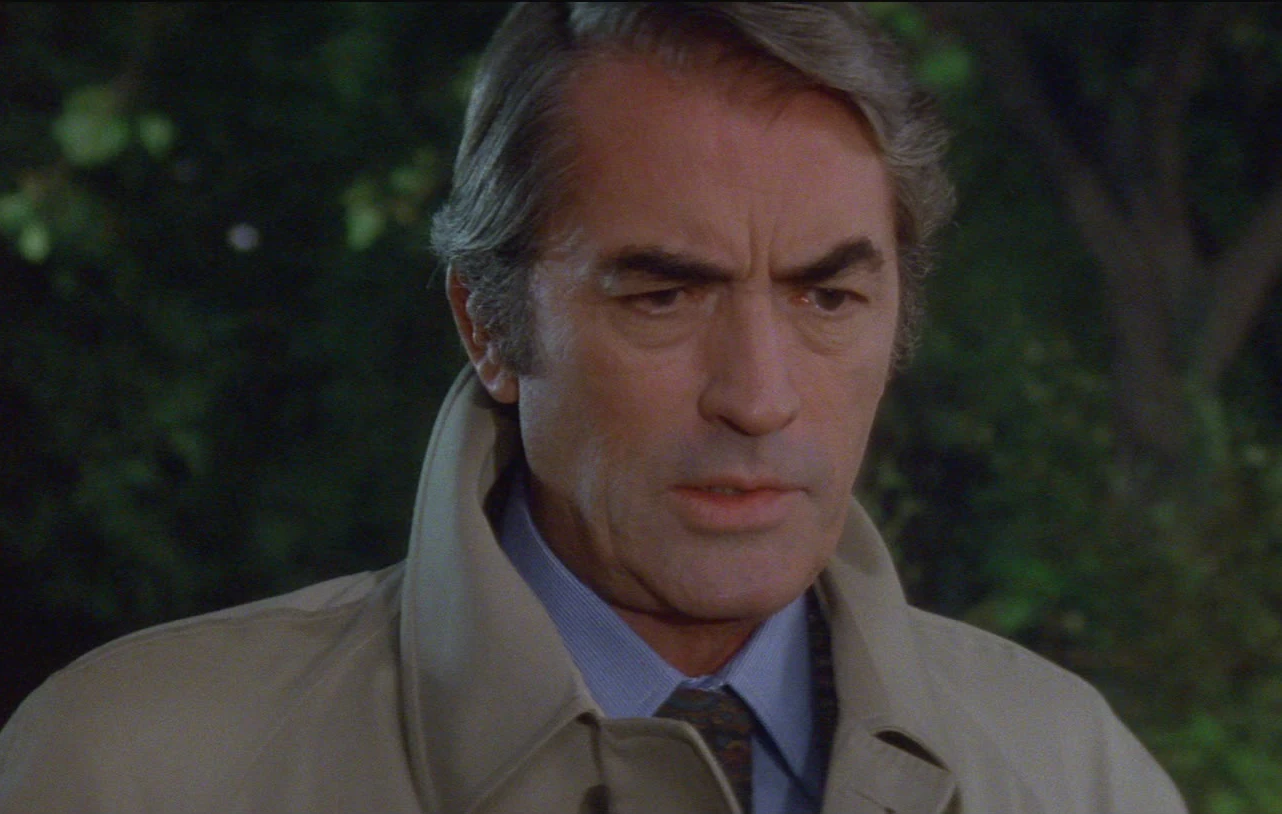
Crucial to grounding the film and preventing it from being overly ridiculous is the grounded lead performance of Peck, whose portrayal of the American diplomat Robert is a rather low-key, charismatic performance that utilizes his natural screen presence particularly well, in the best way I'd say outside of To Kill a Mockingbird. The film and director Richard Donner do well to initially set up the household of the Thorns as being relatively unspectacular, comfortingly warm and sweet, which makes the gradual build-up of horrors quite effective. The fashion in which the film does this is, not going to lie, quite similar to The Exorcist, the film made three years before this on which it had a substantial influence. As great as that film was, and I'll be covering it soon, its first act doesn't have as mind-bogglingly horrifying, scary a scene as Katherine and Robert's child, Damien's (Harvey Spencer Stephens) hangs herself at his fifth birthday party. The scene is truly horrifying and unforgettable.
Unlike another child actor Stephens from another horror film I'll be talking about in a not-too-distant future, Damien is more of a character device to be utilized by the film, than a full-blown character in himself. Which is completely fine since it works extremely well for the film. Damien seems to draw everything away from him, bar the new nanny Mrs Baylock, played by Billie Whitelaw in a performance for the ages. Whitelaw's performance is sort of the bridge between the two styles the film takes, the serious grounded style it uses to set up the horror, and the slightly campier, more overt style to unleash the horror. It evokes something like Kathleen Byron in Black Narcissus in the best possible way and makes each chilling glare and her demonic devotion to Damien so palatably felt. Funny to note how about thirty years later she'd play a seemingly 'nicer' old lady in Hot Fuzz who ends up being just about as equally deranged and violent (Fascist!!)
Damien is the Antichrist. That much is certain, even if it is only directly confirmed much later on in the film. The film doesn't exactly go overboard initially with this, never hammering it into your head; there's the crazed priest figure warning the Thorns about their child, the little foreboding signs, but for the most part the first act post-birthday party is rather understated as Robert goes about finding out about Damien's past. It's definitely creepy though as he and intrepid photographer Keith Jennings (David Warner, excellent as always) gradually piece together what makes Damien Damien. It's all technically speaking rather ridiculous, the whole Satanist conspiracy plot, but the way the film builds it up to you is all extremely effective.
The death scenes in The Omen are probably its most iconic moments. From one of the most harrowing hospital scenes of all time courtesy of Whitelaw, to an unfortunate collision with a mirror that could've been silly, but the way it's carried out by the cinematography of the scene and the foreshadowing of the script beforehand is so fantastic. All through these monstrosities though the film still maanges to capture an emotional drive at its core through Peck's excellent performance, and of course the whole concept of a child of Satan; we wish to see the evil vanquished, but the fact it's such a small, young, seemingly innocent boy whose guilty of all these misdemeanors is in itself quite disturbing.
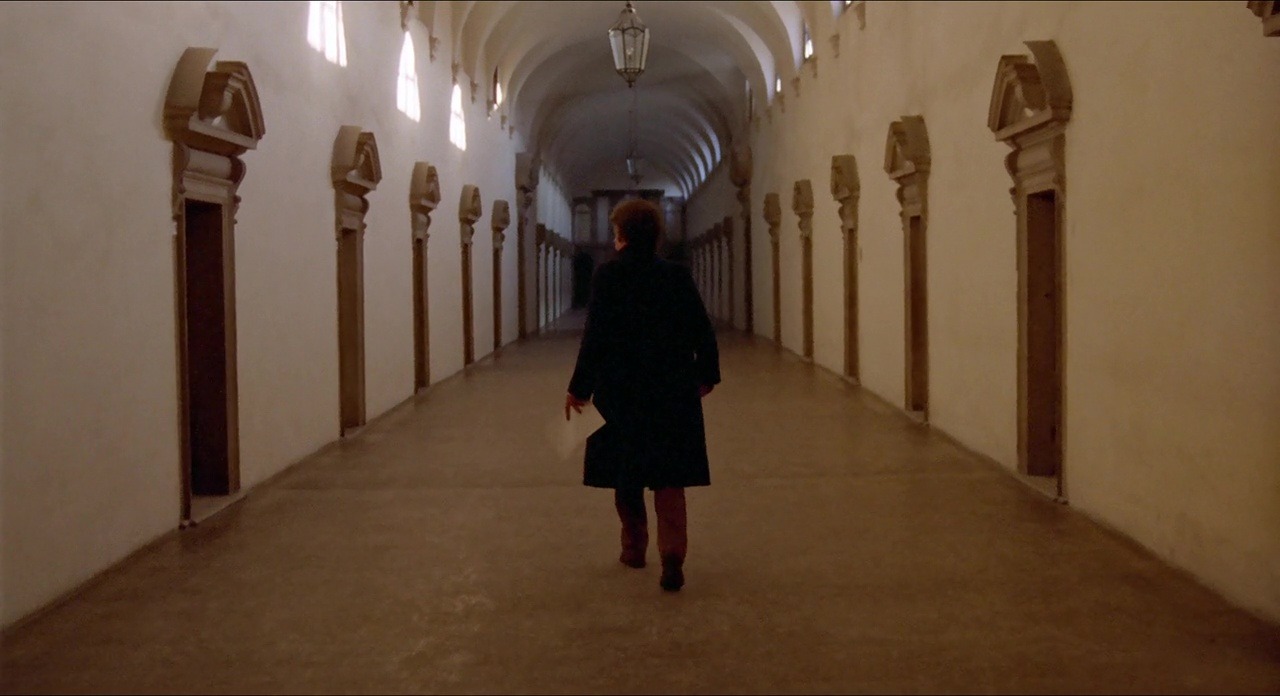
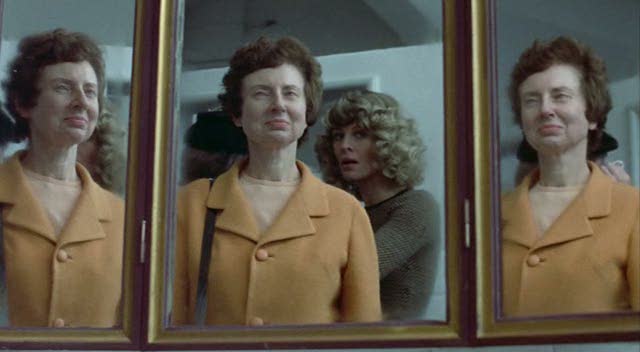
Nicholas Roeg's Don't Look Now I more appreciate for not just the shocks it gives. Its cinematography is absolutely stunning, some of the best of the 70s, and some is indeed used to cultivate a truly creeping sense of atmosphere to the proceedings. In so many other regards though, it's masterful in terms of how it sensitively builds up a rather poignant story of a loving couple (an excellent Julie Christie and an amazing Donald Sutherland) whose marriage is strained by the death of their child. Roeg was sometimes a director who favoured style over substance but that's not the case here, perhaps because he has a Daphne du Maurier story to work from. The brilliant author's short story is brought to life with a style that matches her neo-Gothic tones perfectly. Venice has never looked so beautiful on film and yet at the same time, so brooding. The film's initial tones in fact, in terms of the colour palatte, remind me a bit of In Bruges. A beautiful place, to be sure, but undercut with something slightly sinister.
I'll just show a few more pictures to show how amazing the cinematography by Anthony B. Richmond really is in bringing that very particular sense of atmosphere to the proceedings. It helps to make up for some of the admittedly more dated elements of the film, which aren't all that many on re-watch; some of the slo-mo scenes, some of the musical choices being a bit too on-the-nose (the score itself is great though), that's it really. And it's refreshing to see a love scene like the one here that's so beautifully filmed, the criss-cross editing between the tender physical union and the bland act of getting dressed being as iconic as it is for a reason.
Of course there's a reason I'm doing this as a horror movie countdown segment, and it's because besides being a beautifully made film, it's also deeply disturbing. Everyone probably knows the haunting opening scene and ultimate killer ending, and to be sure that's one of the most equally disturbing and depressing conclusions to a 70s film. But before that there's also tense setpieces that emit foreboding like Sutherland's John Baxter and his close call with death while at work on a restoration piece, and genuinely heart-stopping scenes like the séance. There's also characters like the blind mystic Heather (Hilary Mason) who are initialyl presented as being oh so unnerving but end up becoming one of the more comforting factors of the film. The film is an excellently paced and restrained film that I feel will age like fine wine, and time will come when I'll figure out which one of these two films I prefer.
I was going to do this film as part of my Halloween Top 5 countdown films but, given the nature of the material and the genre, I didn't think it quite appropriate to place on the list. Nevertheless, this harrowing, real-life story enacted into a truly brilliant film is really something, and today I'll be discussing it in some detail...
There's something about depicting horrors that actually happened that renders it particularly tricky. Go too far and you risk exploitation and insensitivity towards the real-life atrocities and tragedies that occurred. Take away too many of the details, and you run the risk of trivialising them. It's worth noting then that so many films use real-life events but as 'inspiration' for fictional narratives, to avoid running this risk. Sometimes they make for great, thought-provoking films, but sometimes it just comes across as filmmakers playing it far too safe.
Occasionally, however, a film decides to take the daring route of actually doing its utmost to bring to life the intensity, the pain and suffering of the real-life events. Schindler's List and Hotel Rwanda are two fantastic examples of how true events of suffering and the searing bravery of individuals who did their best to counteract them, could be drawn in such exceptional fashion, the first in a specifically stylized but still powerful fashion, the latter with such a gritty realism that made it difficult but utterly necessary to watch. 10 Rillington Place is another example of real-life horror brought to cinematic form perfectly. Unlike those films though, who had in Oskar Schindler (Liam Neeson) and Paul Rusesabagina (Don Cheadle) rays of shining light to brighten the darkness, the story of notorious British serial killer John Reginald Christie (Richard Attenborough) and his victims, 10 Rillington Place is bleak through and through.
It's not a serial killer horror film along the lines of theSaw, The Texas Chainsaw Massacre where the gruesomeness and goriness of the murders are the preoccupations, nor is it a procedural like Zodiac or Se7en, or the underrated Citizen X,where the hunting of the serial killer is focused upon, or Silence of the Lambs, Halloween, Peeping Tom or I Saw the Devil where the psyche of the killer is intensely stylized. Those films work incredibly well alongside their respective styles, but 10 Rillington Place takes on an even more daring approach in it completely removes the depiction of a serial killer's lifestyle with a complete lack of style, so to speak. The film horrifies so effectively because it feels so very real and vivid without ever compromising the extreme nature of the material.
Director Richard Fleischer, who did Dr Doolittle with Attenborough four years before this one, could not have picked a more stylistically opposed project to do his second collaboration. Fleischer eschews any of the jolly saturated, multicolored palatte of that family friendly musical and opts for an extremely down-to-earth and straightforward style in depicting the world of 10 Rillington Place. 1940s postwar Britiain is depicted as precisely the rather modest and somewhat grim backdrop you'd imagine it to be, and what's great is that Fleischer never overplays the morbid elements from the outset. He lets the horror of the story come through the scenery, and underrated cinematography (which is rather beautiful in its own very grimy way), instead of making the atmosphere too stiflingly scary from the outset. This plays into the opening scene of the film, where we watch Christie murder his first victim onscreen (though not his first victim overall).
The build-up to the first horrible act is brilliant on many levels. One is of course the direction and the script. Fleischer and screenwriter Clive Exton keep the discourse between Christie and his neighbour Muriel so pleasant and so understated, so like a normal conversation one would have with a neighbour, that it's so jarring and terrifying when we gradually see where Christie's 'medication' for Muriel's bronchitis is leading to. Another part is Attenborough. He's particularly great in just disappearing into the role of Christie immediately. There's that creepiness he brings to the man intrinsically from the outset by that limping walk, those nervily swiveling eyes and best of all, the raspy, whispering voice that is very rarely raised - one of the most chilling deliveries in the film is in an altogether unthreatening situation where he tells a rowing couple to quiet down with a 'now, now' - he's absolutely brilliant in keeping that raspy whisper and yet exuding such creepy, unsettling magnetism to his performance.
The rowing couple in question are Timothy and Beryl Evans (John Hurt and Judy Geeson) . I've talked so much about Hurt's amazing performance before (see here: http://actorvsactor.blogspot.co.uk/2016/04/revised-list-top-30-best-supporting_24.html ), but I'll reiterate again in that his scenes with Geeson, the two actors give an incredibly resonant portrait of a struggling but still loving marriage. They never sugarcoat either characters' faults - Beryl is perhaps too quick to blame Timothy for every aspect of their predicament and too hasty in trying to get an abortion, Timothy likes to tell tall tales about himself a bit too much to compromise for his uneducated and unprivileged background - but instead make them very human characters we don't entirely like, but whom we can completely emphasize with. The relationship between Timothy and his new landlord Christie is particularly brilliant, because the film depicts it as something of a subversion of the usual 'genius serial killer, dimwitted victim' trope. There's nothing grand or extravagant about how Christie strings Timothy along, and Christie is shown not to be exactly the perfect executioner of crimes himself, it's just that Hurt's portrayal of Timothy Evans' weak-willed and unintelligent state is so convincing that you'll believe how Christie can make him go along with his charade involving the cover-up of his murder of Beryl.
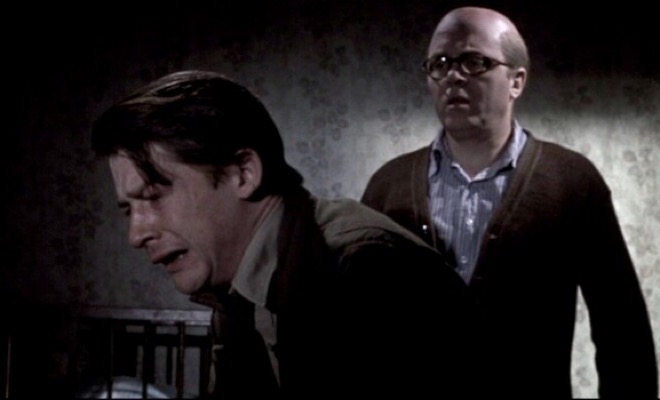
The murder of Beryl is a truly terrifying scene. You know what's going to happen every second of it, but that doesn't stop one from being utterly horrified by every moment of Christie's actions. Both Attenborough and Geeson shine in this scene, and completely earn the horror of the moment; and Attenborough goes a step further by showing such human fear at being found out when an unexpected visitor comes by to check on Beryl. For a moment, we fear with him too before we, horrified, confront ourselves with the fact we're fearing for the fate of a cold-blooded murderer. Hurt himself gets to shine soon afterwards in probably the most heartbreaking scene in movie history when he discovers the body of Beryl. This moment is equally scary as the murder itself; where the act of killing was terrifying on one level, Timothy's reaction is equally so because it puts the audience in his position and makes us heartbreakingly sympathize for this flawed person.
The scenes in which we see the atrocities and the fallout are some of the most masterfully built scenes in film history in terms of not just building tension, but also the visual depiction of its release. Each camera angle in these scenes aren't showy but they're nevertheless incredibly effective, the use of close-ups generating the effects of heartbreak and terror perfectly as we see with such a close, intimate scope precisely what's going on through the characters' heads. The saturated colours and swift movements from varying perspectives in the murder scenes have a certain craftsmanship that don't distract from the overall product but only add to its perfectly attuned claustrophobia and morbidity.
The rest of the film is a cover-up of the murder by both the villain and the victim. What's interesting here is that the 'bad' and 'good' characters in this serial killer film aren't chasing each other, but instead are both being chased. Christie's manipulation of Evans is striking because the film depicts it with such a cold, unsparing tone; you'll entirely believe it too, because of how well drawn the characterizations of both characters have been. Dividing the film into two concurrent sections where Christie covers up his loose ends and Timothy blindly tries to make things better to no avail, they coalesce with Timothy being arrested by the police, leading to yet another amazing Hurt moment where he finds out about his daughter's death for which he is being accused. Hurt's probably my favourite British actor of all-time and his short reaction to this news shows why; he brings all the sadness and terrifying enormity of the news in such an understated but powerful fashion.
I won't lie, I'd say this portion of the film is pretty much dominated by his performance up till his wrongful execution, which is itself one of the most blunt, swift exits for a character onscreen. The way the man we've grown to care for is disposed of in a few seconds is fitting to the tone of the film but also really sends chills down your spine; how easily one man's life, like Christie's victims, could be take in such an immediate instance. Afterwards, Attenborough takes back the reins of the film with aplomb. Christie through Timothy's wrongful accusation for his murders, is a most interesting monster. There's a moment in the courtroom where he bows down his head and breaks down into tears - real? Fake? Tears of joy or sorrow? Christie is a terrible human being through and through, and I think his brief escape of emotion in that scene makes him even scarier and bone-chilling; like us he has moments where he drops his façade and reveals the twisted soul within, who either hates the idea of his victims suffering but can't help enjoying the act of murder, or who loves killing but is forever fearful at being found out. Another particularly great moment towards the end involves Christie and his wife, Ethel (Pat Haywood in an extremely underrated, taken for granted performance). In a brief interaction, we see how someone so close to Christie, who was at some point probably in love and cared for him, finally see him for the appalling human being he is. The film's ending is in a sense, satisfying in that Christie gets his comeuppance. But its postscript is just about as bleak as everything beforehand. The culprit got what he deserved, but the way it's depicted just doesn't feel all that rousing, nor is it meant to be. That it mentions that Timothy Evans posthumously got a reprieve for his wrongfully accused crimes just unsettles the viewer even more - there's not cathartic release because in the end, no real justice was done, and miscarriage of it caused one more death to add to many others.
Note: for the purposes of this list, strictly teachers within an academic environment (so no Mr Miyagi). I also take the importance of role into account, so as much as I love every time Mr Strickland appears in Back to the Future, I can't quite put him on here.
Note: two films I need to see, Stand and Deliver and Picnic at Hanging Rock 10. Dewey Finn (Jack Black), School of Rock
Jack Black is a bit of a mixed bag for me, I love his presence as a member of Tenacious D and in supporting roles in the likes of High Fidelity and King Kong where his enthusiastic presence adds a lot to both films. I like some of his leading man work like in Be Kind Rewind, and I really should check out Bernie sometime soon, but otherwise I've not been particularly keen on him as an actor. I like him best when he's a bit more natural. In School of Rock he's just that, and the film utilizes his character perfectly as a bit of an unwilling spark to its proceedings, a aspiring rock star turned substitute turned rock star again with the help of his students. Though the character is technically self-serving and egotistic, initally, Black's charisma and his chemistry with his child co-stars is undeniably good.
9. Edward R. Rooney (Jeffrey Jones), Ferris Bueller's Day Off
A hilarious performance in a great comedy film, one of my favourites from the 80s, and Jones' deadpan portrayal of the exasparated Dean of Studies who's not entirely unjustified in his pursuit of Ferris Bueller (Matthew Broderick). Jones whole performance is built upon him taking a dead serious and thus, intensely funny approach to the role, which makes scenes like his Clint Eastwood squint scene all the more goofy. The character is not written with all that many lines but Jones milks them for all they're worth, each of his reaction shots are priceless and he has great chemistry with Edie McClurg as his secretary Grace. 8. Clément Mathieu (Gérard Jugnot), The Chorus
A slight, small and rather sweet film that delivers on what it advertises. Mathieu is a quiet, understated, failed musician who comes to a French boarding school for 'troubled' boys to teach them music, and finds in the grounds some kindred souls, in particular Pépinot, a young orphan, and Pierre Morhange, a sullen boy with a beautiful voice. Jugnot's role may be relatively simple, but the script, direction and performance give such life to this kind man who's so inspirational, and yet when the script takes a darker turn in the third act, acts as an equally effective emotional anchor. Jugnot's performance is subtle but in certain moments extremely powerful - the moment he finds out the student's mother he is secretly in love with has found a new partner is heartbreaking. 7. Barbara Covett (Judi Dench), Notes on a Scandal
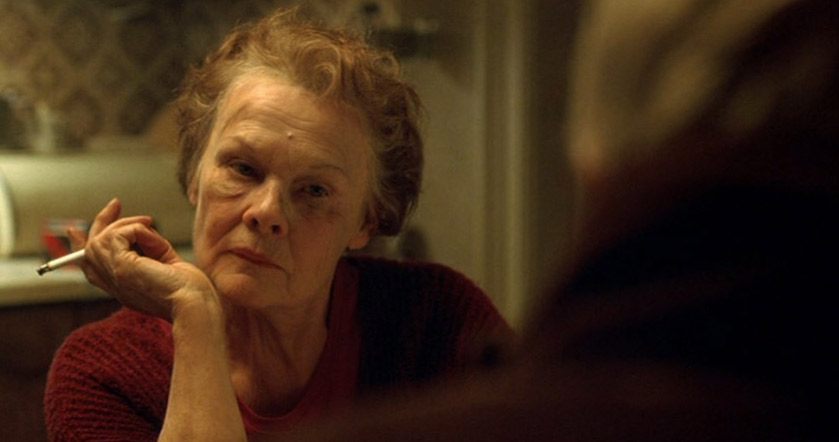
Now for one of the more devious sorts on the list, Dench's performance here is essential to the film working, especially since Cate Blanchett is giving one of her decidedly less effective performances here. As the duplicitous Ms Covett, a quietly charming but innerly calculating spinster who has her eyes on Blanchett's insecure art teacher, Dench does a pretty impressive job of bringing out both the approachable and reprehensible sides to the character. She brings some of that Shakesperean gravitas to the schoolgrounds and gives an otherwise pretty bog-standard 'thriller' some style to spare.
6. Jim McAllister (Matthew Broderick), Election
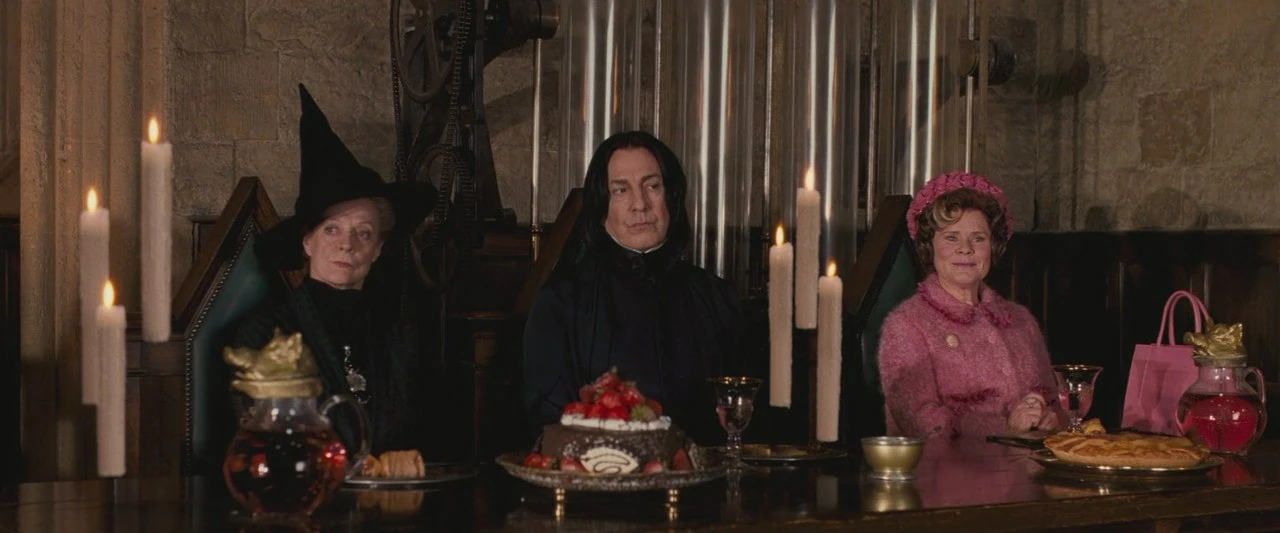
An underrated performance in an underrated film, for sure. Reese Witherspoon's portrayal of Tracy Flick, one of the most reprehensible and yet somewhat endearing high school students ever is the MVP here, but so often neglected is Broderick's work as her nemesis Mr McAllister, the popular schoolteacher who will stop at nothing to bring Flick's student election campaign down. Ferris Bueller playing a self-appointed righteous teacher is already great casting, and to add to that Broderick is hilarious with every one of his reactions to the escalating stakes, plays both the devious and the more genuine sides of his character perfectly, manages to explore the darker side of his character's ego, and manages to somehow make the ending fate of his character somewhat sympathetic (even though he gets everything he deserved, frankly). 5. Professor McGonagall (Maggie Smith)/Severus Snape (Alan Rickman)/Dolores Umbridge (Imelda Staunton), Harry Potter series
Three great British thespians in three perfectly cast roles, even if I'd always imagined Umbridge as more of the toadlike sort. Smith and Rickman were probably the two most consistent actors throughout the whole series (I'd add in Robbie Coltrane as Hagrid if only the last few films didn't shortchange him so much in terms of screentime), with the former blasting out her biting one-liners with such delight, and the latter acting as one of the most intimidating and ultimately heartbreaking anchors of the films. As for Staunton, the films did one thing particularly well in staying true to the book's description of the character; she's sickly sweet, with emphasis on the 'sick', and makes for a great villain to make up for the two relatively underwhelming films she appears in.
4. John Keating (Robin Williams), Dead Poets Society
'O Captain, my captain...' A classic for the ages, Dead Poets Society is perhaps as poignant a watch now as ever with the sad passing of Robin Williams a few years ago. The film is not only notable for his excellent, Oscar-nominated performance as the just about perfect English teacher Mr Keating, who sets fire to convention and encourages his boys to break free of hitherto ordained literary constraints. It's also great in that Keating's relationship with each of the boys, whether it be the shy and tentative Todd Anderson (a very young Ethan Hawke) or the lovelorn Knox Overstreet (Josh Charles), you see how much Keating impacts them in a very specific way. The ending scene is a fantastic ending scene, which is only to be expected for a Peter Weir film, and much of that power comes from how well the teacher-student relationship is built up through the film.
3. Albert Lory (Charles Laughton), This Land is Mine
A powerful film that creeps up on you unsuspectingly, as for a while the film is quite daring in its depiction of Albert Lory, a teacher in an unspecified Nazi-occupied country who is difficult watch in a very unusual way. He's possibly the most weak-willed, unimposing and downright pathetic teacher ever brought to the silver screen. The normally domineering Laughton quite impressively downplays himself into such a meek man and the film in a similar fashion tricks you into thinking it's the lesser of its sums. The film soon takes a darker turn when the Nazis begin interfering with the school and horrifically killing some of its personnel. Laughton brings a gradual growth to his work as Lory gradually finds strength within him to stand up to the Nazis. His final courtroom speech and exit from the classroom is ever bit as moving as Keating's, and is another example of why Laughton was such an exceptional actor. The film though it might not seem much at first, is definitely worth a watch. 2. Mark Thackeray (Sidney Poitier), To Sir, with Love
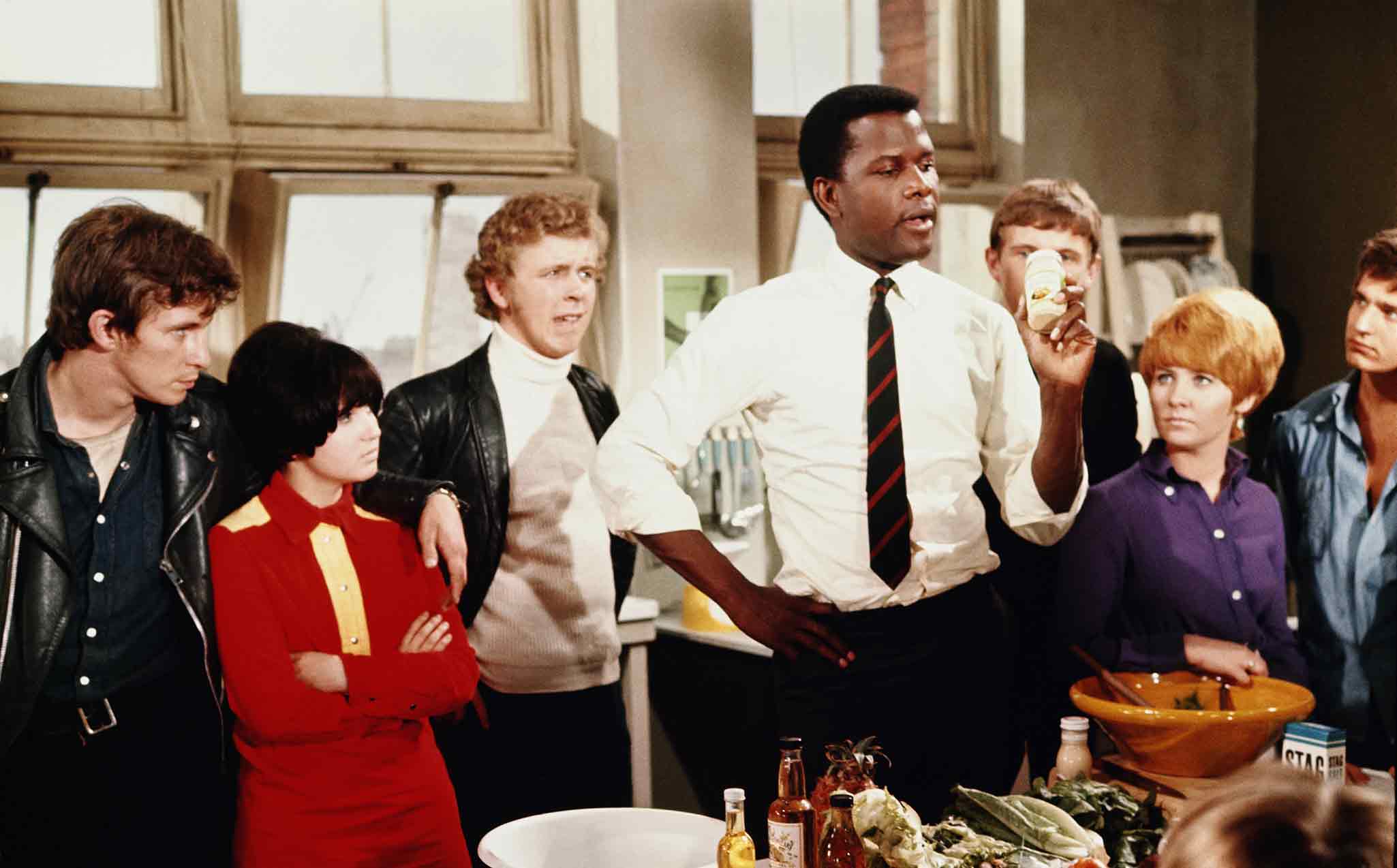
Sidney Poitier as a teacher, in any context, sounds to good to be true. In a well-written role in a fairly impressive film, he's simply perfect. Thackeray is on paper not the most original character, an unemployed engineer from America who goes to East London to take on a teaching position, overseeing a bunch of ruly kids. Yet in Poitier's hands he's one of a kind. Not a perfect man, no, and the film never shies away from the moments he loses his cool and reserve, or his earlier ineptitudes in controlling the class. But he gradually grows into a perfect teacher who brings the whole dysfunctional class together with his tough but loving approach, and no matter what Poitier is doing onscreen he's dynamite to watch. 1. Miss Jean Brodie (Maggie Smith), The Prime of Miss Jean Brodie
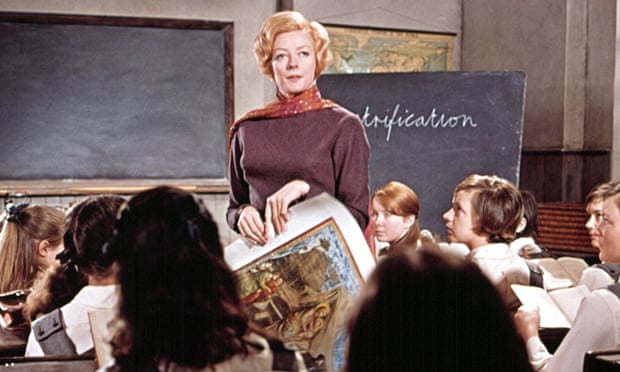
Easy choice, though I'll wait until the future to do an extended discussion of this performance. I've only read one Muriel Spark novel (and a short story), but The Prime of Miss Jean Brodie is one of my all-time favourite books. It's brimming with wit and humour, but also laced with some very dark edges in its depiction of an all-girls school in Edinburgh, and its enigmatic domneering centre. The narrative style of prolepssis sequencing is not retained in the adaptation, but pretty much everything else is retained. The actresses playing the schoolgirls are slightly older for the parts, but due to the sometimes rather mature nature of the source material that's to be expected, and all are effective, especially Pamela Franklin as Sandy. Celia Johnson, one of my favourite actresses is also very strong as the stiff-necked headmistress, but the highlight is of course Smith and the fabulous handling of the writing behind her by Jay Presson Allen. Smith's performance is terrific on all levels from her uniquely handled Scottish accent, her physical portrayal of Brodie's disposition in the classroom, outside of the classroom, with her students and with her lovers. Her clipped, no-nonsense delivery is utlized beautifully here as both a leader of young women and the tyrannical, unsparing presence among them. She makes us completely belive how these young ladies all long to become her, but by the end also realize what a haunting influence she is on their lives.















_4.jpg)